
Outbid.lol Turns Startup Promotion Into a Bidding War
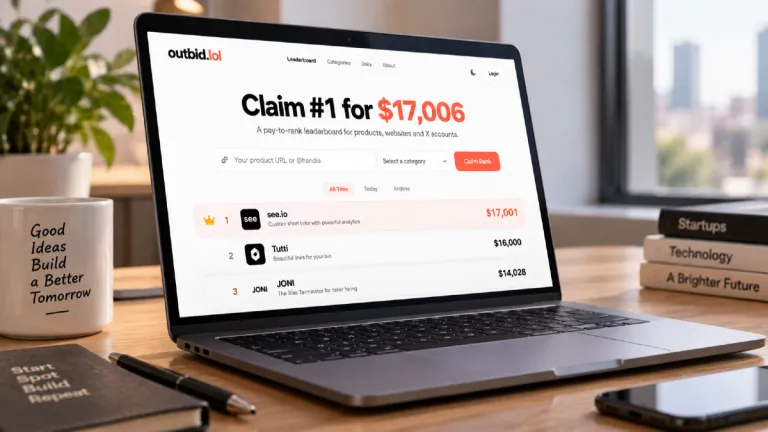
Most startup platforms make companies compete for attention through votes, algorithms, reviews or editorial selection. Outbid.lol takes a much more direct approach: if you want to rank higher, you pay more.
That is essentially the entire idea behind the startup created by German developer Jonathan Wilke. Products, websites and X accounts appear on a public leaderboard where their position is determined by how much has been paid. There are no community upvotes deciding which product deserves the top spot and no complicated system deciding what visitors see first. The highest bidder gets the highest position.
It is an unusually simple idea, but that simplicity became part of its appeal. Shortly after launching in August 2026, the site attracted a large number of visitors, companies began paying increasingly large amounts for prominent positions, copycats appeared and Wilke says he even received a $100,000 offer to sell the project.
What started as a small side project had suddenly turned startup promotion into a public bidding war.
A Leaderboard Where Money Determines the Ranking
Outbid is a combination of a startup directory and an advertising platform. Instead of buying a traditional advertisement or paying for a certain number of views, companies pay to occupy a position on the leaderboard.
The process is intentionally simple. A user submits a product URL or X account, selects a category and chooses how much to pay. The amount determines where the listing appears. New listings currently require a minimum payment of $10, but competing for the most visible positions can cost considerably more.
If another company already occupies the number one position, a challenger has to pay more to move above it. According to the company's own information, taking the top position requires paying at least $5 more than the existing number one listing. Companies that don't want to spend enough to compete for first place can pay smaller amounts and appear further down the leaderboard.
This creates something very different from an ordinary startup directory. Visitors aren't simply browsing products. They can also see the financial competition taking place between them. The amount paid by each listing becomes part of what makes the website interesting.
The platform has also expanded the original idea with different types of rankings. Its all-time leaderboard keeps positions indefinitely, while daily leaderboards reset at midnight UTC and previous results are saved in an archive. There are also categories that allow companies to compete in more specific areas instead of only against every other product on the platform.
The result is a website that can change as companies compete for attention. A company might hold a prominent position today, only to discover that another startup has paid more and moved ahead of it tomorrow.
Built in Hours and Launched as a Side Project
Outbid was created by Jonathan Wilke, an independent developer and entrepreneur from Germany. Wilke is also behind supastarter, a product designed to help developers build and launch software products more quickly.
The project was not introduced as the result of a large development team or a company that had spent months preparing for launch. According to Wilke's own account, the first version was built in only a few hours.
The site officially launched on August 19, 2026. Its idea could be understood almost immediately: submit your product, pay for a position and rank according to how much you spend.
That simplicity is an important part of the story. Many new online products require a long explanation before a potential user understands what they do. Outbid barely needs an explanation at all. A visitor can look at the leaderboard, see the dollar amounts beside the listings and understand what is happening within seconds.
Startup founders already spend money promoting their products through search advertising, social media, newsletters, sponsorships and other websites. Outbid simply offers another way to buy attention.
The important difference is that the competition isn't hidden.
On many advertising platforms, companies are already competing against each other for the best positions, but visitors don't see how much they are paying. Outbid makes that competition public and turns it into part of the website itself.
That simple difference helped people notice it.
From a Small Experiment to More Than a Million Visitors
The launch quickly became much bigger than the small side project Wilke originally created.
According to figures reported around the launch, the platform attracted more than one million visitors within roughly its first two days. One report published shortly after the launch said 705 companies had already taken positions on the leaderboard by the second day. Wilke also reported that the traffic became large enough to overwhelm the service he had initially been using to measure website visitors, forcing him to switch to another provider.
At the same time, the amounts companies were willing to pay began climbing rapidly. Early versions of the leaderboard showed businesses spending thousands of dollars to secure prominent positions. The competition for number one eventually pushed the highest amount into five figures, with the site's About page listing a highest rank of $17,001.
Those numbers helped generate even more attention. Screenshots showing startups paying thousands of dollars to sit at the top of a website were naturally interesting to founders, developers and people following new online businesses. People who had never heard of the platform suddenly had a reason to visit simply to see how high the bidding had gone.
This created a useful cycle for the website. More people talking about it brought more visitors. More visitors made a high position potentially more valuable to companies. That encouraged companies to pay more. Larger payments then gave people another reason to talk about the site.
In other words, the activity happening on the platform helped advertise the platform itself.
The project also began attracting imitators almost immediately. According to the company, at least ten similar websites appeared during its first day, with other developers creating their own versions of the pay-to-rank idea.
Then came another surprising development. Wilke says he received a $100,000 offer to sell the project shortly after launch. He declined the offer.
For a website reportedly built in only a few hours, attracting more than a million visitors, large payments from advertisers, numerous copycats and a six-figure purchase offer within such a short period made this an unusual startup story.
What Makes Outbid Different From Other Startup Platforms?
One obvious comparison is Product Hunt, along with the many startup directories and discovery websites that allow founders to submit new products.
The major difference is how visibility is decided.
On a traditional startup discovery platform, ranking can depend on community votes, popularity, recommendations, editorial decisions or computer systems that decide what to show first. Founders may spend considerable time preparing a launch and encouraging their existing audiences to support it.
Outbid removes most of that.
There are no upvotes determining the top position. There is no need to convince hundreds of supporters to push a launch higher. The principle is simply that your position is determined by what you pay.
That also means its rankings should not be understood in the same way as popularity rankings. A product appearing first isn't necessarily the product users consider best, nor does it mean the platform has chosen it as the best product. It occupies that position because enough money has been paid to put it there.
In that sense, Outbid works more like advertising than a traditional startup ranking website. What makes it unusual is that the competition between advertisers is visible to everyone.
Most online advertising platforms hide this process. Someone searching on Google, for example, doesn't normally see exactly how much each advertiser was willing to pay to appear above another company. Social media users aren't shown a leaderboard displaying which advertisers paid the most for their positions.
Outbid takes that normally hidden competition and puts it directly on the website.
This also explains why the platform can be interesting to people who aren't paying to promote anything. Someone might visit simply because they want to see which company is number one, how much it paid and whether another startup has overtaken it.
That gives people another reason to visit beyond simply discovering new products.
How Outbid Makes Money
Outbid has a very simple way of making money: companies pay for visibility.
There is no complicated subscription system required to understand the business. Every time somebody pays to appear on the leaderboard or improve their position, the platform makes money.
This is different from many new online businesses that first try to attract a large number of free users and only later work out how to make money from them. Outbid was able to start earning money as soon as companies began paying for positions.
It also doesn't sell every position at one fixed price. The competition between companies helps determine how expensive the most desirable positions become.
If few companies care about being number one, the cost of reaching the top remains relatively low. If several companies want the top position and keep competing against each other, the amount required to reach number one can rise considerably.
This raises an obvious question: why would a startup spend thousands of dollars to rank there?
The reason is similar to why businesses spend money on any other form of advertising. They hope the attention they receive will be worth more than the amount they spend.
Startups already pay for Google Ads, social media advertising, influencer promotions, newsletter sponsorships, event sponsorships and other forms of exposure. Outbid offers another option, but presents it in a very different way. Instead of simply buying advertisements, a company publicly takes a position on a competitive leaderboard.
The idea has also drawn comparisons to one of the internet's most famous advertising experiments, the Million Dollar Homepage. Launched by British student Alex Tew in 2005, the website divided its homepage into one million pixels and sold them to advertisers for $1 each. Buyers received a small piece of the page where they could display an image linked to their website. The simple idea became an internet phenomenon and eventually generated more than $1 million in sales.
Outbid follows a different system, but the similarity is easy to see. Both turn advertising space into something people can watch and talk about. The Million Dollar Homepage sold a limited amount of permanent space, while Outbid sells positions on a leaderboard where companies can move above each other by paying more. In both cases, part of the attraction comes from the idea itself: people visit not only to discover the advertisers, but also to see the unusual advertising experiment taking place.
During the platform's initial period of rapid growth, some of the leading listings reportedly received thousands of clicks to their websites. That doesn't mean every company necessarily earned back the money it spent, and there is no guarantee of a particular number of visitors, customers or sales.
Each company still has to decide for itself whether the attention is worth the price.
Funding, Copycats and the Advantage of Being First
Outbid appears to have followed a different path from many startups that raise money from investors before becoming profitable. No publicly announced outside investment round was found during our research for this article. Instead, Wilke launched the project independently and began receiving payments from customers almost immediately.
That makes the reported $100,000 offer to buy the website particularly interesting. Rather than raising outside money to grow the business, the project had already started making money from its users.
However, its rapid success also revealed a possible problem: the basic idea isn't especially difficult for other developers to copy.
A skilled developer can build a similar website with a leaderboard, payment system and rankings. According to the company, numerous similar sites appeared almost immediately after the original began attracting attention.
Its biggest advantage may therefore not be its technology. It may simply be that Outbid became popular first and already has an audience.
That is extremely important for a website selling visibility. A competing site could offer almost exactly the same idea, but if hardly anyone visits it, there is little reason for a company to pay thousands of dollars to appear at the top.
The original site's early popularity gave it something that cannot be copied simply by rebuilding the website: a large number of people who already know about it and have a reason to visit.
The challenge is keeping those people interested after the excitement surrounding the original launch begins to fade.
Can Outbid Turn Its Viral Launch Into a Lasting Business?
This may ultimately be the most interesting question surrounding Outbid.
The website has already shown that its idea can attract a huge amount of attention. What is less certain is whether people and companies will remain interested once the original excitement becomes old news.
Companies have a reason to pay for prominent positions if the site continues receiving visitors. Visitors have a reason to return if the leaderboard remains active, competitive and interesting. Companies bidding against each other make the site more entertaining, while a large audience makes those positions more valuable to the companies paying for them.
When both things happen at the same time, the idea works extremely well.
The challenge comes if one side begins to disappear. If fewer people visit, companies may become less willing to spend large amounts on positions. If companies stop competing for positions, there may be less happening on the leaderboard for visitors to come back and see.
That is why the long-term story may be even more interesting than the launch.
The daily leaderboards, archives and categories already give the original idea more variety and provide companies with additional places to compete. At the same time, the product may not need to become much more complicated.
One of the biggest reasons the website attracted attention in the first place was that almost anyone could understand it immediately: pay more and rank higher.
Outbid doesn't depend on groundbreaking technology or a huge team. Its central idea is remarkably simple. Yet it combines several things people respond to: advertising, competition, curiosity, visibility and the discovery of new products.
Jonathan Wilke launched the project on August 19, 2026 as a small side project reportedly built in only a few hours. Within days, it had attracted enormous traffic, generated substantial income, inspired numerous copycats and, according to Wilke, attracted a $100,000 offer to buy the website.
There is no way to know yet whether that extraordinary beginning will turn into an equally successful long-term business. But Outbid has already demonstrated something interesting: a startup idea doesn't have to be complicated to capture people's attention.
Sometimes a simple idea, presented in exactly the right way, can be enough.
For Outbid, that idea was turning startup promotion into a bidding war.