
BabyLoveGrowth: The AI SEO Tool Putting Organic Growth on Autopilot
SEO software has traditionally helped marketers figure out what to do next. Find a keyword. Analyze a competitor. Identify a technical problem. Track a ranking.
Someone still had to do the work.
BabyLoveGrowth takes a different approach.
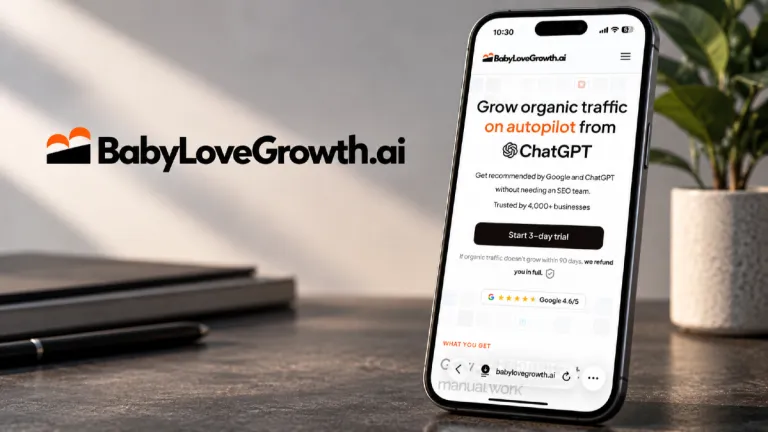
The startup has built an AI SEO tool designed to automate much of the process, including keyword research, content planning, article creation, publishing, technical optimization, backlinks and visibility tracking across traditional and AI-powered search.
Instead of giving businesses another dashboard filled with recommendations, BabyLoveGrowth wants its software to execute more of the strategy itself.
That distinction puts the company in an interesting part of the AI market. Generating text is no longer particularly difficult. The bigger opportunity may be connecting AI-generated content with everything else required to turn that content into organic visibility.
BabyLoveGrowth says its platform is now used by more than 4,000 businesses. Its product has also expanded beyond conventional Google SEO to address discovery through ChatGPT, Claude, Gemini and other AI platforms.
And it all started relatively recently.
From Reddit to an AI SEO platform
BabyLoveGrowth emerged publicly around the beginning of 2025.
In February that year, co-founder Tilen Savnik shared that the startup had reached $850 in monthly recurring revenue in approximately three weeks, with another $1,200 in potential revenue from customers still using trials.
What makes the early story particularly interesting is where those customers came from.
Savnik wasn’t relying primarily on Google Ads or a large launch campaign. Instead, he focused on publishing useful posts and participating in conversations on Reddit.
One OpenAI-related post generated around 480,000 views, while several others attracted tens or hundreds of thousands of views.
The strategy wasn’t simply to distribute links to BabyLoveGrowth. Savnik described an approach centered on contributing useful information and mentioning the product only when it was relevant to the conversation.
For an SEO startup, there is an interesting symmetry to that origin story.
BabyLoveGrowth used content and online visibility to acquire its earliest customers before building a platform designed to help other companies achieve more visibility themselves.
The business has since moved well beyond that initial experiment.
BabyLoveGrowth currently says more than 4,000 businesses use its platform across industries including SaaS, ecommerce, finance, travel and marketing.
That growth has coincided with a broader product strategy. Rather than competing solely as an AI content generator, BabyLoveGrowth has expanded into multiple parts of the organic marketing process.
What does BabyLoveGrowth actually do?
Calling BabyLoveGrowth an AI writing tool doesn’t fully explain the product.
There are already countless AI tools capable of producing a long-form article in seconds. Content generation alone is rapidly becoming a commodity.
BabyLoveGrowth is attempting to automate what happens both before and after the writing.
A business starts by providing information about its website, products, audience and competitors. The platform uses that information to develop a content strategy and identify subjects worth targeting.
Keyword research is integrated into the process. The software analyzes search opportunities, competition and content gaps before creating a publishing plan.
It can then generate articles around those opportunities.
The resulting content can include internal and external links, images, infographics, FAQ sections and structured data.
But generating an article isn’t the final step.
BabyLoveGrowth can connect directly to a website and publish the finished content automatically. Integrations are available for platforms including WordPress, Shopify and Webflow, while an API provides another option for businesses using different systems.
This is where the product becomes more interesting from an automation perspective.
A conventional SEO workflow might involve discovering an opportunity in one platform, moving the keyword into a spreadsheet, creating a content brief, sending it to a writer, reviewing the finished article, sourcing images, adding internal links and finally uploading everything to a CMS.
An AI tool that only writes the article removes one part of that workflow.
BabyLoveGrowth is trying to remove several.
For a founder or small company without a dedicated SEO department, that distinction matters. The value proposition isn’t simply that an article can be created faster. It’s that a larger portion of the recurring work involved in maintaining a content strategy can happen automatically.
The platform also performs technical SEO audits, looking for issues that could affect organic performance. That pushes BabyLoveGrowth further toward becoming an all-in-one system rather than another specialized content generator.
SEO is expanding into AI search
The timing of BabyLoveGrowth’s development is significant because the definition of search itself is changing.
Google remains enormously important, but it is no longer the only place people go when they want an answer.
Someone looking for accounting software, a project-management platform or a marketing service may now ask ChatGPT, Claude or Gemini for suggestions rather than beginning with a conventional search engine.
That behavioral shift has created growing interest in Generative Engine Optimization (GEO) and Answer Engine Optimization (AEO).
The terminology is still developing, but the underlying objective is straightforward: companies want to be visible when AI systems generate answers about products, industries and problems relevant to their businesses.
BabyLoveGrowth has incorporated this into its platform.
The software can monitor selected prompts across major AI assistants and track whether a customer’s brand appears in their responses.
This introduces a fundamentally different measurement from conventional rank tracking.
Traditional SEO asks:
Where does my website rank for this search?
AI search introduces another question:
Does the AI mention my company when someone asks this question?
Those aren’t necessarily the same thing.
A search engine can present a page containing numerous links and leave the user to choose between them. An AI assistant may synthesize information and directly mention only a small number of companies.
Being visible in that environment could therefore become increasingly important as more consumers use AI for research and product discovery.
BabyLoveGrowth is positioning itself for a world where businesses may need to manage both forms of visibility simultaneously.
The company refers to this broader approach as SEO and AEO, combining traditional organic search with optimization for answer engines.
It’s an important expansion of the original SEO software model.
Businesses may eventually care not only about whether their website ranks on Google, but whether their company is being surfaced across an entire ecosystem of AI-generated answers.
Backlinks and community visibility
Creating content is only one side of SEO.
A website can publish hundreds of articles and still struggle to compete for valuable searches if it lacks authority.
Backlinks remain an important part of that equation, but acquiring them has traditionally been one of the most difficult aspects of SEO to scale.
Companies may spend considerable time on outreach, digital PR, partnerships and guest posting in an attempt to earn relevant links.
BabyLoveGrowth approaches the problem differently.
The company has developed a network of participating websites through which businesses can receive contextual backlinks. It currently advertises access to more than 4,000 partner websites.
That network turns link building into part of the subscription rather than an entirely separate marketing operation.
It’s also one of the features that most clearly separates BabyLoveGrowth from a conventional AI content tool.
Creating an article with AI is relatively easy. Building external signals around that article is much harder.
By combining the two, BabyLoveGrowth is attempting to automate both content production and part of the authority-building process that follows it.
There is an important SEO consideration here. Automated or network-based link acquisition still needs to be judged by the quality, relevance and nature of individual placements. More backlinks do not automatically mean better SEO, and businesses using any link-building service should consider current search-engine guidelines when evaluating how links are acquired.
BabyLoveGrowth’s approach extends beyond websites as well.
The platform can identify relevant discussions on Reddit and Quora where a business could potentially participate or be mentioned.
That may sound more like social marketing than SEO, but the boundaries between the two are becoming less distinct.
Reddit discussions frequently appear prominently in Google results. Online conversations can also influence how brands are discovered, researched and discussed across the wider web.
The rise of AI search adds another dimension because these systems rely on information distributed across many different sources.
For businesses, visibility increasingly means being present in the places where customers look for answers rather than concentrating exclusively on their own websites.
BabyLoveGrowth is trying to bring those different forms of visibility into the same system.
Pricing and the agency opportunity
BabyLoveGrowth currently offers two main subscription levels.
The Grow plan costs $99 per month and includes 30 branded SEO and AEO articles each month, keyword research, automated publishing, technical optimization, backlink access and monitoring for ten AI prompts.
The company also offers a three-day trial and advertises a 90-day money-back guarantee tied to improvements in organic visibility.
The Scale plan costs $399 per month.
It increases production to 120 articles across four languages, expands AI visibility tracking to 50 prompts and includes higher-authority backlink opportunities. Customers also receive unlimited seats, priority support and access to an SEO/GEO specialist.
Those prices become more interesting when BabyLoveGrowth is viewed as something broader than an AI writer.
A company building the same workflow manually could potentially use separate services for keyword research, content production, technical SEO, publishing, backlink acquisition and monitoring.
An integrated AI platform changes that calculation.
It doesn’t necessarily mean automation can replace the quality or strategic judgment of an experienced SEO team. But smaller businesses that would never employ specialists for each individual function suddenly have access to capabilities that would previously have required considerably more resources.
BabyLoveGrowth is also applying the model to another potentially valuable market: agencies.
Its white-label offering allows SEO and marketing agencies to provide the platform under their own branding, including their own logo, colors and domain.
The white-label product currently carries a $2,000 one-time setup fee plus $99 per website per month.
That could create a different growth channel for the company.
An agency can use the technology as infrastructure behind its own service while continuing to manage client relationships, strategy and any additional work internally.
The economics are different from selling subscriptions individually. One agency could potentially bring many client websites onto the underlying platform.
It also reflects a broader opportunity for AI tools.
Some of the most valuable AI companies may not ultimately be the products consumers interact with directly. They could be the infrastructure quietly powering services sold by other businesses.
For BabyLoveGrowth, white-label SEO creates an opportunity to operate on both sides of that market.
Can SEO really run on autopilot?
The biggest question surrounding BabyLoveGrowth isn’t whether AI can write a blog post.
That problem has largely been solved.
The harder challenge is deciding what should be written, understanding why it matters, publishing it correctly, building authority around it and measuring whether any of that work actually improves visibility.
That’s the part of SEO BabyLoveGrowth is trying to automate.
There are obvious limits.
Producing more content doesn’t guarantee more traffic, and more traffic doesn’t necessarily produce more customers. An automated system still needs accurate information, a sound strategy and enough quality control to make sure increased output doesn’t simply scale the wrong decisions.
This becomes particularly important when AI dramatically reduces the cost of production.
If producing another article is cheap, deciding whether that article should exist becomes more valuable.
If publishing can happen automatically, reviewing the direction of the overall strategy becomes more important.
And if an AI tool can perform dozens of SEO tasks simultaneously, businesses need to understand which tasks are actually contributing to growth.
That tension is what makes this category interesting.
The goal isn’t necessarily to eliminate human judgment. It’s to reduce the amount of repetitive execution required after those judgments have been made.
For a small company, that could mean maintaining an active organic growth strategy without building an internal SEO department. For an agency, it could mean serving more clients without increasing production resources at the same rate.
Search itself is also becoming more complicated. Businesses now have to think about traditional rankings while beginning to consider how they appear in AI-generated answers and other emerging discovery channels.
Managing all of those surfaces manually could become increasingly difficult.
That creates an opportunity for software capable of coordinating the work rather than merely providing another set of analytics.
And that’s ultimately the more ambitious idea behind BabyLoveGrowth: not another AI tool that tells businesses how to improve their SEO, but a platform designed to do more of the work for them.