
Befit Is Turning Workouts Into a Global Business
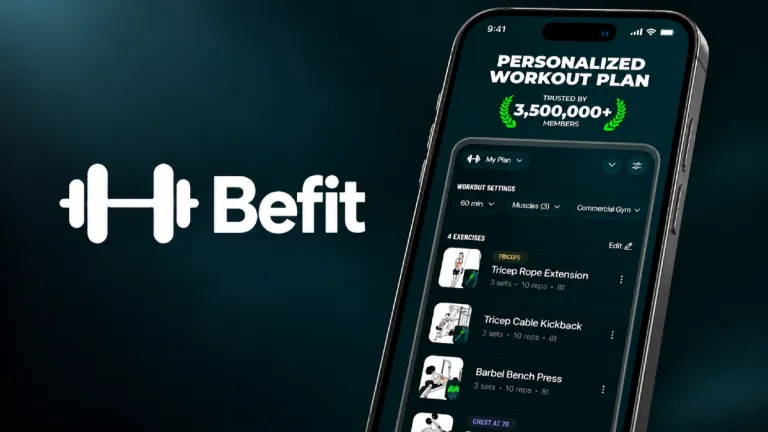
The fitness app market is hardly short of competition. There are apps for running, calorie tracking, home workouts, weightlifting, yoga and almost every other form of exercise imaginable. That makes the speed at which Befit has grown particularly interesting.
Founded in 2024 and launched in January 2025, Befit has already surpassed 3 million downloads and says it now has paying subscribers in more than 170 countries. The company has grown from a new Brazilian fitness app into an increasingly global platform in less than two years.
Behind that growth is a relatively simple idea. Instead of giving everyone the same workout plan, Befit builds strength-training programs around each person’s goals, experience and available equipment. Artificial intelligence helps personalize those programs, but the broader product is designed around something much more familiar: helping people know what to do when they walk into a gym.
It is an approach that appears to be working. Befit reported R$13 million in revenue during its first 15 months of operation, while more than half of its revenue was already coming from outside Brazil by early 2026.
For a startup that only began development in 2024, Befit has moved remarkably quickly.
A Second Startup for Carlos Terceiro
Befit did not begin with a first-time founder learning how to build a mobile app.
Founder Carlos Terceiro had already spent more than a decade building consumer technology products before starting the company.
In 2014, Terceiro co-founded Mobills, a personal finance app designed to help people manage their money. Mobills eventually accumulated more than 30 million downloads, participated in Google’s Launchpad accelerator and was acquired by Toro Investimentos, part of Santander Brasil, in 2021.
After years focused heavily on work, Terceiro began paying more attention to his own health and started strength training. What began as a personal lifestyle change eventually exposed what he saw as a product opportunity.
There were already countless fitness apps in the app stores, but Terceiro felt many of them still left users with the same fundamental problem: they did not know exactly what they should be doing in the gym.
Some apps were essentially workout logs. Others provided libraries containing hundreds or thousands of exercises. More expensive alternatives connected users with personal trainers.
Befit was designed to sit somewhere between those options.
Development began in 2024 using the founders’ own resources. Rather than immediately releasing a basic version and adding the training system later, the team spent around eight months building the initial product before launching it publicly in January 2025.
Terceiro was later joined by Claret Sabioni, who brought experience in growth, data and new ventures, including previous roles at companies such as Wildlife Studios and QuintoAndar.
The founders also had something in common beyond technology. Both had experienced periods of sedentary living and understood how difficult it could be to turn the intention to exercise into a consistent routine.
That experience helped shape Befit’s central belief: many people do not necessarily need more motivation to exercise. They need more structure.
Befit Starts by Asking What You Actually Need
Opening a traditional workout app can sometimes feel like opening a large exercise encyclopedia.
Befit takes a different approach.
The app asks about the user’s goals, training experience, available equipment and how often they want to exercise. It then uses that information to create a personalized training plan.
Someone trying to build muscle in a fully equipped gym should therefore receive a different program from a beginner training at home with limited equipment.
The system is built around a curated database of more than 500 exercises. Befit says its exercises, programs and algorithms are developed with input from certified fitness professionals and specialists in exercise science.
Artificial intelligence is used to organize recommendations based on information such as the user’s profile, goals, equipment and previous training history.
Importantly, however, Befit is not simply a text box where users ask an AI chatbot what exercises they should perform.
The personalized plan sits inside a complete workout application.
Users can follow exercises through videos and instructions, record sets and weights, monitor training volume, track streaks and view changes in performance over time. They can also create workouts themselves or modify the plans generated for them.
That distinction matters.
Generating a workout plan is relatively easy. Building an app people continue opening several times every week is much harder.
Befit’s challenge is therefore not just producing a good first workout. It is becoming part of the user’s routine.
The company has gradually expanded the product around that idea. Apple Watch support allows users to follow exercises and record sets without repeatedly reaching for their phones, while Apple Health integration synchronizes workout, heart-rate and calorie information.
In July 2026, Befit also became an integration partner for Strava’s expanding strength-training experience. Completed Befit workouts can now be shared automatically to Strava, bringing strength sessions into the same social environment already used by runners and cyclists around the world.
These additions move Befit beyond the original idea of generating a personalized gym plan. It is increasingly becoming a place to plan, perform, record and understand strength training.
From Zero to Millions of Downloads
Befit’s early growth is what makes the company particularly notable.
The app launched in January 2025.
By the end of that year, the company said it had reached 24,000 paying subscribers, considerably ahead of its original target of 10,000. Around its first anniversary, Terceiro said Befit had passed one million downloads and reached 35,000 active subscribers.
He also reported more than $1 million in annual recurring revenue and said the business had been profitable since its first month. Those figures were shared by the founder rather than independently audited financial statements, but they provide a useful picture of how quickly the subscription business developed.
The growth continued into 2026.
By March, Befit reported reaching 2 million users. By April, that figure had risen beyond 2.4 million.
The company’s current website says Befit has now surpassed 3 million downloads and has paying subscribers in more than 170 countries. It is available on both iOS and Android and supports multiple languages including Portuguese, English, Spanish, German, French and Italian.
Befit also says Sensor Tower data ranked it as the fastest-growing workout app during 2025 and 2026.
Revenue has grown alongside the user base.
According to Brazilian business publication Exame, Befit generated R$5 million during its first full year of operation. The company was targeting R$25 million in revenue for 2026.
Another report published in May said Befit had generated R$13 million during its first 15 months, including more than half of that amount during the first quarter of 2026.
Those are unusually substantial numbers for a consumer app that was still being developed in 2024.
But perhaps the more important number is where that money is coming from.
Befit Was Built to Leave Brazil
Many consumer startups become successful in their home country and only later begin thinking seriously about international expansion.
Befit says it took the opposite approach.
The company was designed as an international product from the beginning, initially supporting Portuguese, English and Spanish rather than building exclusively for Brazil.
That decision is beginning to show in the revenue mix.
By May 2026, 52% of Befit’s revenue was reportedly already coming from outside Brazil, compared with 48% domestically. The United States alone accounted for 29% of revenue, while other international markets included Latin America and India.
That is an important distinction for Befit.
Millions of downloads in one home market can produce an impressive headline without proving that a product will travel. Generating more than half of revenue internationally suggests the underlying proposition is translating across borders.
The company has also appeared high in health and fitness app rankings in markets including Chile, Peru, Colombia, Mexico and India.
Its international growth is particularly notable because Befit entered one of the most crowded categories in mobile software.
Users can already choose between established products covering workout tracking, running, nutrition, connected fitness and personalized coaching. Befit is competing not only for downloads but for something much more difficult: a recurring subscription.
In the United States, Befit’s pricing typically ranges from around $19.99 per month to discounted annual plans around $69.99, although prices vary by country and promotion.
That subscription model means Befit does not need every person who downloads the app to become a customer. But it does need enough users to find continuing value in the product to justify paying for it month after month or year after year.
International revenue suggests that at least a meaningful portion are doing exactly that.
Growth Has Been Engineered, Not Accidental
There is another reason to be careful when looking at Befit’s download numbers.
This is not simply a fitness app that suddenly went viral.
The company has deliberately invested in acquiring users.
During its initial growth phase, Befit concentrated heavily on digital marketing through platforms including Google, Meta and TikTok. The strategy was to validate the product, grow the subscriber base and learn which users converted before spending more heavily on traditional brand building.
That background makes the company’s profitability claim particularly interesting.
Fast-growing consumer apps can often generate enormous download numbers by spending aggressively on advertising. Downloads alone therefore say relatively little about the quality of the underlying business.
Befit appears to have approached paid acquisition with the experience of a founder who has already spent years scaling consumer mobile products.
The company first focused on whether acquired users would actually subscribe. Once the model began working, it increased its ambitions.
For 2026, Befit has said it plans to continue performance marketing while investing more heavily in international brand building and partnerships with fitness influencers.
It is also exploring relationships with gyms, which could potentially give the company another distribution channel beyond app-store advertising.
This is one of the more interesting parts of the Befit story.
The technology is important, but technology alone does not explain how a fitness app goes from zero to millions of downloads in such a short period.
Distribution matters just as much.
Terceiro had already built a consumer app to tens of millions of downloads before starting Befit. The new company combines that experience in mobile product development and user acquisition with a subscription category where customers can potentially remain for years.
If Befit can keep the economics of that acquisition working as it moves deeper into markets such as the United States, its early growth could prove much more durable than a temporary app-store spike.
The Hard Part Starts After the First Workout
Befit has grown quickly, but fitness apps face an unusually difficult retention problem.
January is full of new gym memberships, new diets and new workout apps. Keeping those users engaged in March, June and December is another matter entirely.
Personalization may help Befit solve part of that problem. A workout plan that changes with the user should theoretically remain more useful than a static PDF or generic routine downloaded from the internet.
The company is already moving further in that direction.
Befit has discussed an AI Coach designed to follow a user’s training history and adjust recommendations as that person progresses. Instead of simply generating an initial plan, the goal is to create something closer to continuous coaching.
But this also puts Befit into increasingly competitive territory.
The largest fitness platforms have enormous user bases, established brands and years of training data. New AI tools are also making personalized workout generation easier for competitors to reproduce.
Befit therefore cannot rely on artificial intelligence alone as its long-term advantage.
Even Terceiro has argued publicly that simply having access to AI is no longer much of a differentiator. The advantage comes from turning the technology into something users actually value.
For Befit, that means the quality of the workouts, simplicity of the interface, accuracy of progression, integrations, tracking and ultimately whether users become stronger and keep returning.
Its early numbers suggest the company has found something people want.
The next test is whether it can turn that early adoption into a global fitness brand.
Befit Is Trying to Become More Than Another Workout App
There is an interesting contrast at the center of Befit.
The technology behind the product is becoming more sophisticated, but the problem it is trying to solve remains extremely simple.
A person walks into a gym.
What should they do?
How much weight should they use?
How many sets?
What should they train next?
And how do they know whether they are actually improving?
For decades, the best answer was often a personal trainer. The internet later produced workout websites, YouTube videos, spreadsheets and thousands of fitness apps, but the information itself can become another problem. There is now so much fitness advice available that deciding what to follow can be harder than finding advice in the first place.
Befit is betting that many users do not want more information.
They want a plan.
That helps explain why the company’s rapid growth is worth watching. Befit was founded in 2024, launched in 2025 and has already reached millions of downloads, paying subscribers across more than 170 countries and a revenue base increasingly generated outside its home market.
There is still a large distance between a fast-growing workout app and a company capable of competing globally with the biggest names in fitness technology.
But Befit has already crossed one of the hardest barriers for a young consumer startup: people are not merely downloading the product.
Thousands are paying for it.
And they are doing so around the world.
For a company that barely existed two years ago, that makes Befit one of the more interesting new fitness startups to watch.