
Blow Up: The Two-Person Startup Helping TikTok Creators Go Viral
Growing an audience on TikTok can be unpredictable. Creators spend hours developing ideas, testing different formats, and analyzing their results, often without understanding why some videos succeed while others attract little attention. French entrepreneurs Robin Dormion and Enzo Dijoux set out to make that process more manageable.
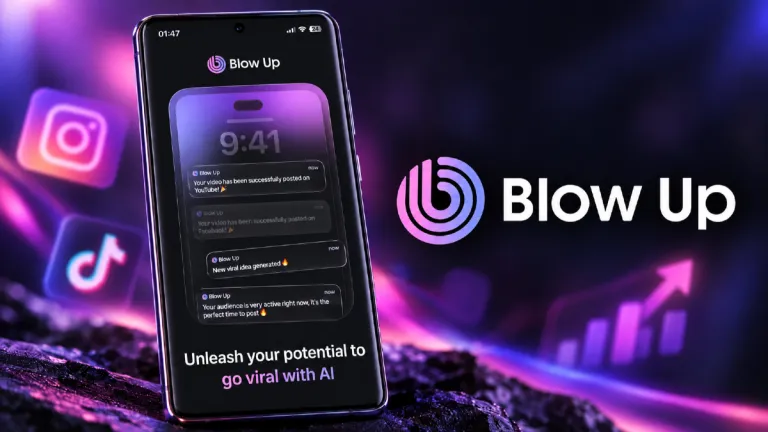
Their startup, Blow Up, available at blowup-app.com, combines artificial intelligence, social media analytics, content recommendations, and automated publishing in a mobile application designed to help creators improve their reach. What began as a small project developed by two entrepreneurs has evolved into a growing subscription business with hundreds of thousands of app installations.
From Content Creation to Building a Software Business
Blow Up was created by Robin Dormion and Enzo Dijoux, two French entrepreneurs who brought different skills to the venture. Dormion concentrated on marketing, audience development, and business growth, while Dijoux handled the technical side of building the application.
Before launching Blow Up, Dormion had experience selling online training programs and creating content for social media. He has publicly discussed generating hundreds of millions of views through short-form videos, gaining practical experience in what attracts attention across different platforms.
That experience eventually helped inspire the business. Publishing videos across TikTok, Instagram, Facebook, and YouTube required repetitive work, even when the underlying content was identical. Automating that process offered an opportunity to save creators time while helping them reach audiences on multiple platforms.
Dijoux, meanwhile, had an established background in software development. Historical legal documents from December 2024 identify his French business as the original publisher of Blow Up, suggesting that the product began taking shape before its later international expansion.
The founders subsequently developed Blow Up into a broader AI-powered creator assistant. Rather than focusing exclusively on distributing videos, the application expanded toward analyzing accounts, identifying content opportunities, and helping users create videos with greater growth potential.
Two Founders Who Documented Their Startup Journey
One unusual aspect of Blow Up’s story is the founders’ willingness to document their entrepreneurial journey publicly. Instead of presenting only a polished finished product, Dormion and Dijoux recorded their experiences building the company.
Their documentary, titled On a Monté une Application de 0 à 100 000€ par mois, follows the project over approximately one year. It explores their early decisions, marketing experiments, setbacks, and the personal experiences behind developing a subscription-based application.
The documentary also reflects a division of responsibilities that became important to the business. Dijoux concentrated on developing and improving the software, while Dormion experimented with ways to reach potential customers through social media.
In one public account, Dijoux described generating $4,260 in a week after promoting a feature that notified creators when their audiences were most active. The remarkable part was that the advertised feature had not yet been completed when the campaign began, and the team developed it shortly afterward.
The episode illustrates the founders’ emphasis on testing demand and improving the product quickly. It also highlights how aggressively Blow Up experimented with marketing during its early development.
Building an AI Assistant for Social Media Growth
Blow Up is primarily designed for creators who want to understand their social media performance and develop content more efficiently. Its approach combines account analysis, recommendations, content creation assistance, and distribution tools within one application.
Users can connect their TikTok accounts and receive an AI-generated assessment of their profiles. The system examines available account and content information to identify strengths, weaknesses, and potential opportunities for improvement.
The application can also generate video concepts and scripts tailored to a creator’s niche. Additional features include hashtag suggestions, analysis of existing videos, and notifications intended to help users identify suitable publishing times.
Another important component is automated cross-platform distribution. Blow Up offers tools to repost content across TikTok, Instagram, YouTube, and Facebook, reducing the need to upload the same video separately to different services.
The product operates in a competitive market that includes social media management platforms, scheduling applications, and AI content assistants. Tools such as Buffer, Later, Metricool, and various AI video-analysis products address overlapping needs, although Blow Up places particular emphasis on short-form content creation and TikTok growth.
Its central proposition is straightforward: help creators spend less time on repetitive tasks and more time producing content that has a better chance of reaching an audience.
From €3,000 to €200,000 in Monthly Recurring Revenue
Blow Up’s reported commercial growth is one of the most interesting parts of its story. According to figures shared publicly by Dormion, the business increased its monthly recurring revenue from approximately €3,000 in October to €200,000 in May 2026.
Those figures represent the founder’s account of the company’s subscription revenue rather than independently audited financial results. Nevertheless, they provide an indication of the scale the business claims to have reached in a relatively short period.
Dormion has also stated that the company achieved this growth without raising external investment. Although historical funding details are not independently documented in full, the founders have consistently presented Blow Up as a business developed without traditional venture capital financing.
The mobile application has demonstrated measurable traction beyond those financial claims. By October 2026, Google Play displayed more than 500,000 Android downloads, while independent app intelligence provider AppBrain estimated approximately 790,000 cumulative Android installations.
The company also reports that its AI has analyzed more than 480,000 creator accounts. That figure is published on Blow Up’s own website and should be understood as a company-reported usage metric rather than a verified count of paying customers.
Blow Up operates through a subscription-based model. The application is free to download, while premium features, including more advanced analysis, content generation, and automated publishing capabilities, require payment.
The Creator Network Behind Blow Up’s Growth
One of Blow Up’s most distinctive strategies is how it promotes itself. Rather than relying entirely on conventional advertising, the company has built a network of creators who produce social media content about the application.
Dormion initially promoted Blow Up through his own content. As the business expanded, the founders experimented with distributing promotional videos through additional creators and social media accounts.
Eventually, Blow Up developed a performance-based creator program that rewarded participants according to the views their videos generated. The strategy allowed the company to turn individual creators into an important part of its customer acquisition operation.
Dormion reported that the company’s promotional content grew from approximately 9 million monthly views in January to 200 million in May 2026. He also stated that Blow Up paid more than $100,000 to participating creators over a five-month period.
These figures are founder-reported marketing results, but the underlying approach offers an interesting example of modern consumer application distribution. Rather than simply purchasing traditional advertisements, Blow Up invested in people who could create and distribute content that appealed directly to its target audience.
The strategy also connects the company’s marketing to the problem its product aims to solve. Blow Up sells tools for social media growth while using social media creators to drive awareness of the application itself.
Managing Rapid Growth and User Expectations
Rapid adoption creates challenges, particularly for subscription applications that promise to help users improve unpredictable outcomes such as social media performance.
Blow Up has accumulated thousands of app store ratings, including many positive reviews from users who appreciate its content suggestions and simplified workflow. However, some customers have also criticized its subscription requirements, limited access to premium functionality, and the usefulness of certain AI-generated recommendations.
These concerns are relevant because no software application can guarantee that a video will become viral. Social media performance depends on numerous factors beyond the control of any analytics or content-generation tool.
The company’s legal terms acknowledge limitations in AI-generated recommendations and describe the use of third-party AI technologies. This places Blow Up within a broader category of products that combine existing AI models with specialized interfaces, user workflows, and distribution features.
Maintaining customer satisfaction will therefore be important as the business develops. Attracting users through viral promotional campaigns is one challenge; convincing them that the product delivers continuing value is another.
Blow Up’s ability to balance aggressive customer acquisition with product improvements, transparent subscription terms, and long-term retention will help determine whether its early momentum becomes sustainable growth.
A Startup Built Around the Power of Distribution
Blow Up illustrates how a small founding team can build and market a software product without initially requiring a large organization or traditional venture capital investment.
The company has combined software development, existing AI technology, subscription monetization, and a creator-led marketing strategy to compete in an increasingly crowded market. Its publicly reported revenue growth and independently observed app installations suggest that the approach has generated meaningful commercial interest.
Perhaps the most interesting aspect of Blow Up is that its founders did not rely solely on technological innovation. Much of the company’s progress appears to have come from understanding its audience, experimenting with different marketing approaches, and building a distribution network capable of reaching large numbers of potential customers.
The business has grown beyond its original two-person founding operation, but its early story remains a useful example of how complementary technical and marketing skills can help transform a narrowly focused idea into a substantial digital product.
Whether Blow Up becomes a lasting name in the creator economy will depend on what happens after the initial attention. For now, its emergence demonstrates that building a successful consumer application increasingly involves understanding not only how to develop software, but also how to get people to discover it.