
Explee Is Putting B2B Outbound Sales on Autopilot
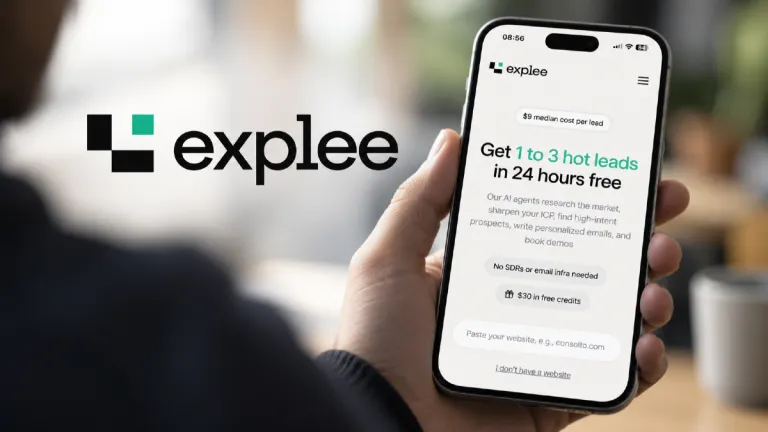
For a small company, finding customers can become a job of its own.
First you need to decide what kind of businesses might buy what you are selling. Then you need to find those businesses, identify the right people inside them, track down their contact details, write emails that do not look like spam and remember to follow up when nobody replies.
Explee wants to make much of that work disappear.
Founded in 2024, the London-based startup began by building a smarter way for businesses to find potential customers. Instead of clicking through endless database filters, users could simply describe the type of company they wanted to reach and let Explee search for matches.
But finding the right people was only the beginning.
In 2026, Explee expanded the idea with a product called AutoGTM. Rather than stopping after finding potential customers, it can research them, write personalized emails, send the messages, follow up and help turn replies into meetings.
The ambition has therefore grown considerably in two years. Explee started by helping companies answer a simple question: Who should we sell to?
Now it increasingly wants to handle what happens next.
The founders had already built companies before Explee
Explee may be young, but some of the people behind it are not new to building technology companies.
One of the central figures is Khariton Matveev, who previously co-founded Skyeng, an online education company that grew into one of Eastern Europe’s largest education technology businesses.
Matveev helped start Skyeng in 2012 and spent more than a decade with the company. During that period, he worked on the product side of the business as Skyeng developed from an online English-learning service into a much broader education platform.
That experience matters to the Explee story because it means this is not simply a group of founders attaching artificial intelligence to an existing type of software and hoping to find a market.
Alex Kataev brings another connection to Skyeng. Before Explee, Kataev served as Skyeng’s chief technology officer and later founded Eightify, an AI product that summarizes YouTube videos. Eightify found a substantial audience of its own and was included in Andreessen Horowitz’s list of prominent generative AI consumer products.
The two backgrounds are an interesting combination.
Matveev had spent years helping build a large online education business. Kataev had worked on the technical side of that same company and then moved into the new generation of AI products.
By 2024, their attention had shifted toward another problem: finding customers.
Explee Ltd was incorporated in the UK in June of that year. Today, Matveev and Kataev are both significant shareholders in the company. Vladimir Baiandin, who has also been closely involved with Explee and regularly discusses its product publicly, joined them as a company director in April 2026.
The startup they are building sits in a market that is already enormous. Businesses around the world pay for software that helps sales teams discover companies and the people working inside them.
Explee’s starting point was to make that search feel less like operating a database.
What if you could just describe the customer you want?
Traditional sales databases often make users think like the database.
Imagine you have built software for independent hotels. You might search for hospitality companies in certain countries, choose a range for company size, select particular job titles and continue narrowing the results until you have something resembling a useful list.
That works, but it assumes you already know exactly which boxes to tick.
Explee took a more conversational approach.
A user can describe the type of customer they are looking for in ordinary language. Explee then searches its information about businesses and people to find companies that fit the description.
The difference sounds small, but it changes how the product feels.
Instead of saying, “show me companies with these seven database attributes,” a business can effectively say, “find companies that look like my best customers.”
Explee says its database now covers more than 105 million companies and 536 million people. It has also searched tens of millions of company websites to find businesses that may not appear clearly in the usual sources used by sales teams.
That became one of the startup’s early selling points.
In 2025, Explee said expanding its information beyond the usual business databases had dramatically increased the number of companies it could find in some categories. The company gave examples ranging from recruitment agencies in the United States to hair salons in France and medical equipment companies in Vietnam.
The goal was straightforward: help businesses discover potential customers they might otherwise miss.
There are signs that people found the approach useful. Explee has received a small number of independent reviews from users who particularly mention the speed of finding prospects and the ability to search using normal language.
But there was an obvious limitation.
Even a perfect list of potential customers is still only a list.
Someone has to contact them.
That realization helps explain where Explee went next.
Explee decided finding leads was not enough
In May 2026, Explee publicly launched AutoGTM.
The name sounds more complicated than the idea behind it.
AutoGTM is essentially Explee’s attempt to turn its customer-finding technology into an automated salesperson for the earliest part of the sales process.
It is important to make the distinction clear: AutoGTM is not a separate company replacing Explee. It is a product built by Explee and represents the next step in what the company is trying to do.
Instead of asking a user to search Explee for potential customers and then take the results somewhere else, the company began asking a bigger question:
What if Explee could do the next part too?
A business can give Explee its website. The software reads the site to understand what the company sells and starts looking for businesses that could potentially buy it.
It then tries to find the appropriate people inside those companies.
After that, it can write an individual email for each prospect, send it and follow up. When somebody responds positively, the conversation can move toward an actual sales meeting.
The easiest way to understand the difference is to imagine a small business owner sitting down on Monday morning to find new customers.
Previously, Explee might have helped that person produce the list.
With AutoGTM, Explee is trying to do much of the Monday morning work itself.
The company demonstrates the idea using a wholesale artificial-flower supplier. Explee examines what the supplier sells and identifies groups that might buy from it, such as wedding planners, event designers and boutique hotels. It then finds relevant people at those businesses and creates outreach based on what each company actually does.
If wedding planners respond while another group consistently ignores the emails, the system can put more effort into the group that is working.
That makes AutoGTM easier to understand as an evolution of Explee rather than a completely new direction.
Explee spent its first phase getting better at answering who should we contact?
AutoGTM adds now contact them.
Thousands of companies are already trying it
Explee is still young enough that its growth figures need some context.
The company currently says its automated sales agents have generated more than 133,000 “hot leads” for almost 12,000 companies. Explee describes a hot lead as a prospect that has shown meaningful interest rather than simply someone whose email address has been found.
Those numbers come from Explee itself and have not been independently verified, so they should not be treated as the same thing as audited customer or revenue figures.
What is interesting is how quickly the counters have been moving.
Recently indexed versions of Explee’s website showed considerably fewer companies and leads, suggesting that use of the product has been growing rapidly since AutoGTM became publicly available.
There are other signs of real usage too. Explee has received independent software reviews, continues to release new parts of the product and has built connections with other common business tools.
The pricing also says something about the type of customer Explee wants to attract.
Many sales products charge monthly subscriptions. A company may need several of them at once: one to find businesses, another to find email addresses and another to send and manage the outreach.
Explee has taken a different approach with its automated sales product.
AutoGTM is pay-as-you-go. Instead of committing to another large monthly software bill, a company can add money to an account and spend it as Explee sends outreach.
The company currently says that $30 can cover roughly 1,000 emails. Explee estimates that this could result in two to eight interested leads and one or two meetings, although those numbers are naturally going to vary enormously depending on what is being sold and who is being contacted.
That uncertainty is important.
Software can automate sending an email. It cannot force somebody to want what is being sold.
But the low starting cost makes the product relatively easy for a founder or small business to experiment with.
And that may be where Explee has its best opportunity.
The real competition may be a founder doing everything manually
Explee is entering a crowded market.
Companies such as Apollo and ZoomInfo already help businesses find potential customers. Clay has become popular for combining different sources of business information and automating parts of the prospecting process. A growing number of AI startups are also promising to automate sales work.
Trying to beat all of them feature by feature would be a difficult strategy.
But Explee becomes more interesting when viewed from the perspective of a very small company.
Imagine two founders have spent six months building a product.
They do not have a sales department. They do not have somebody dedicated to researching potential customers. They may not even know what software they are supposed to buy.
One of the founders simply has to start selling.
That can mean spending evenings searching LinkedIn, building spreadsheets, looking for email addresses and writing messages to people who may never respond.
For that person, Explee does not necessarily have to replace an established sales system.
It has to replace the spreadsheet and several hours of repetitive work.
That is a much simpler proposition.
It also explains why the company’s move from lead discovery into automated outreach makes sense. Once Explee had helped a founder find 500 relevant companies, the obvious next question was why that founder should have to manually contact all 500.
The more of those steps Explee can remove, the less its customers need to understand about sales software in the first place.
Eventually, the experience could become remarkably simple:
Here is my business.
Find people who might buy from me.
Start conversations with them.
That is a much more ambitious product than a searchable database.
Making sales easier also makes bad sales easier
There is an uncomfortable side to this kind of automation.
Nobody wants an inbox filled with hundreds of obviously automated sales messages.
If AI makes it dramatically easier for every company to contact thousands of people, simply sending more emails will not be an advantage for very long.
The companies building these systems therefore face an unusual challenge: they need to make automated sales feel less automated.
That means finding the right people becomes more important, not less.
An email sent to someone who has no reason to buy the product is still spam, regardless of how cleverly AI personalized the opening sentence. Explee therefore has to prove that its ability to understand businesses and identify likely customers is good enough to make the outreach useful.
Early user feedback also shows why the distinction matters. One reviewer reported receiving fewer actual leads than initially expected, even though the overall review of Explee remained positive.
There are legal and privacy considerations as well. Different countries have different rules around contacting people for business purposes, and Explee makes clear that customers remain responsible for using contact information appropriately and respecting requests not to be contacted.
Automation does not remove those responsibilities.
In fact, the easier it becomes to send outreach at scale, the more important restraint may become.
The winning sales agent may not be the one capable of sending the most emails. It may be the one that knows which emails should never be sent.
Explee is trying to turn sales into something you can switch on
There is a broader shift happening in software that helps explain why Explee is interesting now.
For decades, business software has mostly given people tools.
Accounting software helped an accountant work faster. Design software helped a designer create things. Sales software gave salespeople better information about potential customers.
AI is beginning to change that relationship.
Instead of asking software to help with every individual step, users can increasingly describe the result they want and let the software attempt the work between the beginning and the end.
Explee’s evolution over its first two years is a small example of that change.
It began by making it easier to find companies.
Then it started researching them.
Then it began finding the right people inside them.
Now it can contact those people and continue the conversation.
The next question is how far that process can realistically go before a human needs to take over.
Complex sales will still require trust, judgment, negotiation and actual conversations between people. Explee does not eliminate that part.
What it may be able to eliminate is much of the work required to reach that conversation in the first place.
For a large corporation, that could make an existing sales operation more efficient.
For a tiny startup with no sales team, it could mean something more fundamental: having a sales operation at all.
That is what makes Explee worth spotting. The company started by building a better way to find potential customers, but it is now testing a considerably bigger idea — whether finding and approaching those customers can become something a small business simply switches on.