
Minimal Built a Smartphone for People Who Want to Use Their Smartphone Less
Most smartphone companies want you to spend more time on your phone. Minimal is building one around the opposite idea.
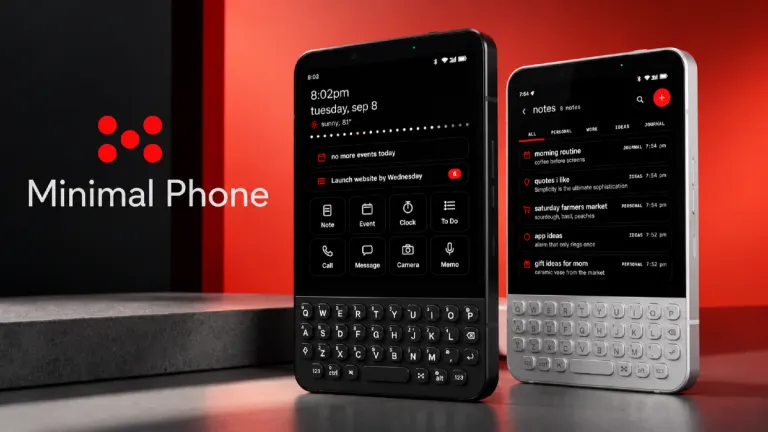
The Minimal Phone 2 is a small Android smartphone with a physical keyboard and software designed to make checking your phone less tempting. It can still run the apps people depend on every day, but Minimal wants the phone to feel more like a useful tool and less like something constantly competing for your attention.
That idea has already found an audience. The Minimal Phone 2 raised almost $2.3 million on Kickstarter from 3,416 backers, despite starting with a funding goal of just $100,000.
A smartphone designed to be used less
Minimal isn’t trying to take smartphones back to the days when phones could only call and text.
The Minimal Phone 2 still runs Android. You can download regular apps, use Google Play, make payments, use banking apps, take photos and do the other things people expect from a modern smartphone.
The difference is how all of that is presented.
Instead of a huge screen filling almost the entire front of the device, the Minimal Phone 2 has a compact four-inch display with a physical keyboard underneath it. Its software is built around reducing distractions while still giving users access to the apps they need.
It’s an unusual approach. Minimal isn’t trying to make the smartphone less capable. It’s trying to make people less interested in constantly looking at it.
Minimal already tried this once
The Minimal Phone 2 isn’t the company’s first attempt at solving the problem.
The original Minimal Phone took the idea much further. It combined Android and a physical keyboard with an E Ink screen — the kind of display technology commonly associated with e-readers.
That made the phone unusual, but it also created compromises. E Ink works well when displaying relatively static information, but modern apps are designed for fast-moving color screens.
Minimal hasn’t simply repeated the same formula with its second phone.
The company says it spent roughly a year working on the Minimal Phone 2 and deliberately waited until it had a functioning device before announcing it rather than showing people a concept or a collection of computer-generated images.
And one of the biggest changes is also the most surprising.
This time, Minimal gave it a better screen
The Minimal Phone 2 abandons the E Ink display and uses a regular color screen instead.
At first, that might sound like Minimal is moving away from its original mission. A duller, slower screen should theoretically make a phone less tempting to use.
But there’s another way to look at it.
A phone doesn’t necessarily need to be frustrating to use in order to encourage you to use it less.
Minimal is shifting more of that responsibility to the overall design of the phone and its software. The screen can work properly with modern apps, while the smaller size, physical keyboard and focus-oriented software are there to change how you interact with it.
It’s a significant change in philosophy: make the phone less distracting without making it less useful.
The physical keyboard is back
The other thing that immediately separates the Minimal Phone 2 from almost every mainstream smartphone is impossible to miss.
It has actual buttons.
The physical keyboard takes up a substantial part of the front of the phone. The keys can also respond to touch, allowing someone to scroll and move around the phone without constantly reaching up to the screen.
Minimal is even producing different physical keyboards for different languages, including English, French, German, Korean and Arabic.
There is obviously some nostalgia here for anyone who remembers BlackBerry-style phones, but the keyboard also serves a practical purpose. If the goal is to make a smartphone feel more like something you deliberately use rather than endlessly swipe through, replacing part of the screen with physical keys makes sense.
It still needs to work as your only phone
This may be the most important part of Minimal’s idea.
There are already simple phones designed for people who want fewer digital distractions. The problem is that leaving the modern smartphone ecosystem completely can be difficult.
People need maps, banking apps, messaging, authentication apps, payments, cameras, music and work apps.
Minimal isn’t asking people to give those things up.
The Minimal Phone 2 runs regular Android apps and comes with Google services and the Play Store. Minimal is also offering a separate option for more advanced users who want to run the phone without Google’s services.
That puts Minimal in an interesting middle ground.
It isn’t really a dumb phone, and it isn’t trying to compete with the biggest smartphones by giving people an even larger screen and even more reasons to look at it.
It’s attempting to build a fully capable smartphone for someone who would rather keep that smartphone in their pocket.
Nearly $2.3 million shows there’s demand for a different kind of smartphone
Building hardware is expensive, and Minimal is still a small company.
That makes the response to its second phone particularly notable.
The Kickstarter campaign ran for 30 days, from August 10 to September 9, 2026. By the time it closed, 3,416 people had backed the project with a combined $2,298,355 — more than 22 times its original $100,000 goal.
Minimal continued changing the phone during the campaign too. After feedback from its community, the company increased the battery size, gave preorder models more memory and improved the physical keyboard so it could also respond to touch.
The finished product still has to prove itself in customers’ hands. Minimal Phone 2 is currently available for preorder, with shipping scheduled for December 2026, so it would be premature to judge how well the new approach works in everyday life.
But the crowdfunding response already tells us something important. Thousands of people were willing to pay for a smartphone designed around spending less time on a smartphone.
A different answer to the smartphone problem
For years, the smartphone industry has largely followed the same direction.
Screens became bigger. Apps became more immersive. Notifications multiplied. Social platforms became better at keeping people scrolling.
Minimal is asking what happens if a phone moves in the other direction without abandoning everything useful about a smartphone.
The Minimal Phone 2 isn’t trying to eliminate technology from someone’s life. It’s trying to make technology easier to put down.
And in an industry built around getting people to look at screens, that makes Minimal a particularly interesting company to watch.