
Muse.ai: Meta’s New Personal AI Agent Wants to Do More Than Just Answer Questions
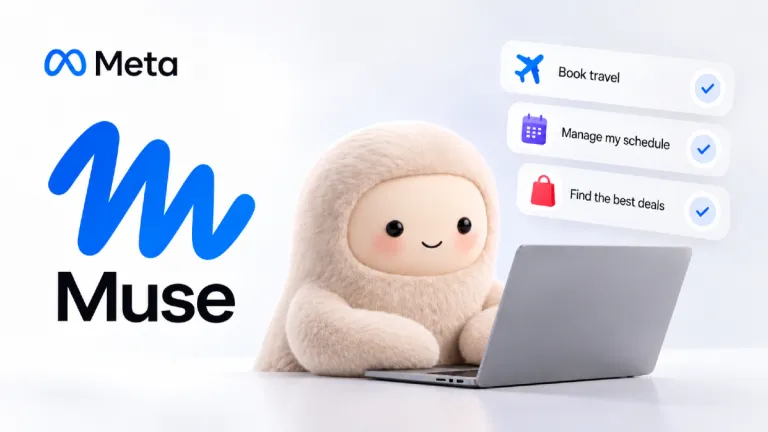
Most AI assistants are very good at telling you what to do. Meta wants its new AI agent to actually do it for you.
Launched on September 8, 2026, Muse.ai is Meta’s new personal AI agent, designed to move beyond the familiar question-and-answer experience of traditional AI chatbots. Instead of simply generating instructions, recommendations or text, Muse can take actions on a user’s behalf, from managing emails and schedules to shopping, booking travel and working toward longer-term goals.
The launch is part of Meta CEO Mark Zuckerberg’s broader push toward what the company calls “personal superintelligence”: AI that understands individual users well enough to become genuinely useful across different parts of their lives.
And despite being one of the newest major AI products on the market, Muse has wasted little time attracting attention.
It has also attracted a large following on Instagram in a remarkably short period of time.
For a product that has only just arrived, Meta has already managed to put Muse in front of a very large audience.
What is Muse?
Meta describes Muse as a “personal AI agent,” and the word agent is important.
Chatbots such as ChatGPT helped popularize the idea of having a conversation with artificial intelligence. You ask a question, the AI responds, and you decide what to do with the information.
AI agents are intended to take that process another step.
Tell Muse that you need to organize a trip, for example, and the goal is not simply for it to suggest destinations or produce a packing list. Muse can browse websites, fill out forms, book travel and continue working on tasks after you close the app.
The same principle applies to everyday jobs.
Muse can help manage email, resolve scheduling conflicts, book restaurant reservations, set reminders, find deals and work through longer projects. Users can also give it broader goals, after which Muse can develop a plan and continue advancing the work over time.
Behind the scenes, Muse runs on a dedicated virtual computer in the cloud called Muse Secure VM. This gives the agent its own environment where it can use a browser and interact with online services.
Users decide which services Muse can access, and for sensitive actions such as sending an email or completing a purchase, Muse is designed to ask for approval first.
The result is something closer to delegating a task to a digital assistant than simply chatting with a language model.
Mark Zuckerberg’s bigger AI bet
Muse is not a small experimental product sitting on the edge of Meta’s business.
It fits directly into Mark Zuckerberg’s much broader vision for the future of artificial intelligence.
Zuckerberg has increasingly described Meta’s AI ambitions around the idea of “personal superintelligence”: powerful AI that is available to individuals and helps them achieve personal goals rather than existing only as a centralized system used by businesses or researchers.
Muse represents one of the clearest consumer products built around that idea.
There is another reason Zuckerberg’s involvement matters.
Meta already controls some of the largest consumer platforms in the world, including Facebook, Instagram, Messenger and WhatsApp. Building an AI agent is one challenge. Getting hundreds of millions or potentially billions of people to encounter and use that agent is another.
Meta already has the distribution.
Muse is available through its own app and website and can also be used through WhatsApp. Meta has said that support for its AI glasses is coming as well.
That gives Muse a very different starting position from a typical AI startup trying to acquire its first users one download at a time.
From launch to #1 in ten days
The speed of Muse’s early growth is one of the most interesting parts of the launch.
Only two days after its release, Muse had already climbed to #2 on the U.S. App Store charts.
Eight days later, it reached #1 among free iPhone apps in the United States.
Those rankings will naturally change over time, but the speed of the climb is more significant than any single position.
Muse has also built a substantial social presence shortly after launch, gaining a large number of Instagram followers in a remarkably short period of time.
That is hardly surprising for a product created by the company that owns Instagram, but it still demonstrates how aggressively Meta can introduce a new consumer brand.
What was muse.ai before Meta?
The Muse name may be new to Meta’s AI strategy, but the muse.ai domain has a history that predates the current product.
Before becoming the home of Meta’s personal AI agent, muse.ai was associated with an independent AI-powered video platform.
The company offered video hosting, search and related tools under the muse.ai name.
In March 2026, the platform announced that muse.ai was becoming Skiv, moving its service to skiv.com. Existing videos, collections, accounts and API keys remained part of the same platform under the new identity.
Several months later, Meta launched its new Muse at muse.ai.
But the domain wasn’t the only valuable piece of the Muse identity that changed hands.
The British rock band Muse had long used @muse on Instagram. Before Meta unveiled its new AI agent, the band switched its Instagram username to @museband. When Meta officially launched Muse in September, its new AI product was using the coveted @muse handle.
The exact circumstances behind the change have not been publicly disclosed. There is no confirmed information showing whether Meta acquired the handle through an agreement with the band, whether money changed hands or whether another arrangement was made.
What is clear is that Meta’s new AI product now has both muse.ai and @muse, giving it an unusually strong combination of domain name and social media branding from the very beginning.
The old video platform and Meta’s current Muse should therefore not be confused. They are different products. The previous service continues under the Skiv brand, while muse.ai now represents Meta’s personal AI agent.
Who funded Muse?
Unlike most products covered by StartupSpotting, Muse does not have a traditional startup funding story.
There was no seed round followed by Series A or Series B financing.
Muse is a product developed inside Meta, one of the largest technology companies in the world, and its development forms part of Meta’s much larger investment in artificial intelligence, models, computing infrastructure and Meta Superintelligence Labs.
That distinction matters when looking at Muse as a new product.
A newly launched AI startup might need to raise tens or hundreds of millions of dollars to train models, rent computing capacity, recruit researchers, acquire users and build the infrastructure required to operate an autonomous agent.
Muse starts with Meta behind it.
That means Muse does not have a publicly disclosed standalone funding total in the conventional startup sense. Its resources ultimately come from Meta.
This also gives Meta considerably more room to experiment with how Muse makes money.
Muse has launched with a free tier for everyday use alongside paid subscriptions for people who require significantly more usage and computing capacity.
If Muse eventually becomes capable of routinely shopping, negotiating bills, finding products, arranging travel and completing transactions, commerce could become particularly important as well.
An AI agent involved in what people buy is potentially sitting much closer to the transaction than a conventional search engine or chatbot.
Why Muse could matter
There is no shortage of AI assistants.
That alone would make another chatbot from a major technology company considerably less interesting.
Muse matters because Meta is trying to change the role AI plays in the interaction.
Instead of:
Ask → receive an answer → do the work yourself
the model becomes:
Give Muse a goal → approve important decisions → let the agent do the work
That is a much bigger behavioral shift.
The difficult part may not be building an AI capable of performing those tasks. It may be convincing people to give an AI enough access to actually perform them.
An agent that manages email needs access to email. One that manages a calendar needs access to a calendar. An agent that shops for you may eventually need access to payment systems, addresses, preferences and purchase history.
Meta has clearly anticipated that challenge.
Users control which services Muse can access, and the agent asks for approval before certain sensitive actions. Meta says Muse conversations and data stored inside its virtual environment are not shared with its advertising systems, while users can opt out of having their interactions used to train Meta’s AI models.
Those protections will likely be central to whether people become comfortable handing increasingly important tasks to AI agents.
Muse is still extremely new.
The bigger test comes next.
If users begin trusting AI not only to answer their questions but also to manage schedules, send emails, shop, book travel and quietly work toward goals in the background, the distinction between an AI chatbot and a personal agent could become increasingly important.
Meta is betting heavily that this is where consumer AI is heading.
And with Mark Zuckerberg putting personal superintelligence at the center of the company’s AI strategy, Meta’s enormous distribution network behind it and rapid growth immediately after launch, Muse.ai is starting that experiment with considerably more momentum than most new AI products ever get.