
Quority Built One Place to Manage Your Meta, Google and TikTok Ad Accounts
Running ads sounds simple when a business has one advertising account. Add a payment method, create a campaign and start spending money.
The picture changes quickly for an agency managing dozens of clients or a company advertising across several countries and platforms. There can be multiple advertising accounts, different budgets, invoices, payment methods and platform rules to keep track of across Meta, Google and TikTok. An account restriction can also suddenly stop campaigns that a business depends on.
Quority is building a platform around that problem.
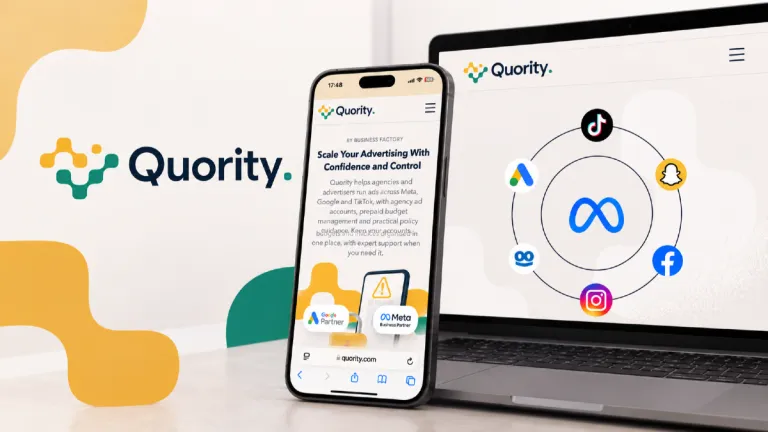
The Czech company gives businesses and agencies access to agency advertising accounts across Meta, Google and TikTok while bringing budgets, spending, invoices, reporting and advertising compliance into one place.
Instead of trying to become another place for creating ads, Quority focuses on much of the infrastructure surrounding them.
Quority launched in 2024
The project that became Quority officially started in January 2024, with a pilot version opening to clients in July of that year.
The idea did not come from simply spotting an opportunity in advertising software. The team had already encountered many of these problems while working with online advertisers, including companies operating in industries where advertising rules can be particularly complicated.
Quority was created by the team behind marketing agency Business Factory, which had been providing advertising-account and compliance services before the standalone platform existed. That gave Quority experience with the problem it was attempting to turn into software.
The platform was developed to centralize work that otherwise involved different systems and a considerable amount of manual administration. Advertising accounts, spending and client information could be brought into one interface rather than tracked separately.
What had initially been built around an existing advertising operation gradually became a product clients could access themselves.
Today, Quority operates as a platform focused specifically on advertising infrastructure rather than simply functioning as another marketing agency service.
What exactly is an agency ad account?
One part of Quority can sound confusing if you have never worked in digital advertising before: agency ad accounts.
Businesses can normally open advertising accounts directly with platforms such as Meta, Google or TikTok. For a small advertiser with one business and a limited number of campaigns, that may be all that is needed.
Large agencies operate differently.
Because they manage advertising for multiple clients and potentially significant amounts of spending, agencies can have established relationships and account structures with the advertising platforms. These agency setups allow them to manage advertising accounts for clients while handling things such as access, billing and support in a more centralized way.
Quority provides access to this type of infrastructure.
A customer can get agency advertising accounts for Meta, Google and TikTok through Quority rather than having to establish separate arrangements for every platform.
That distinction is important. Quority is not its own advertising network. The advertisements still run on Facebook and Instagram through Meta, in Google products through Google Ads, or on TikTok. Quority sits between the advertiser and those platforms and helps manage the accounts and processes surrounding the campaigns.
One place for Meta, Google and TikTok
Once advertisers begin operating across multiple platforms, fragmentation becomes part of the problem.
A company might have several Meta accounts, another group of Google Ads accounts and separate TikTok accounts. An agency could be doing the same thing for dozens of different clients.
Quority gives customers a central place to see and manage that account structure.
Users can keep track of advertising accounts, monitor balances and spending, allocate budgets, access reporting and manage invoices through the platform. This means the administrative side of advertising does not have to be spread across as many separate systems.
Quority also supports multiple markets and currencies, which becomes increasingly relevant for advertisers operating internationally.
The value of that approach increases with scale. A business running one Facebook campaign probably does not need an entire infrastructure platform. An agency responsible for many accounts across several advertising networks has a very different problem.
Quority is primarily building for the latter.
You fund Quority, and Quority handles the ad billing
The way advertising money moves through the platform is another important part of the product.
Quority operates using a prepaid model. Customers send their advertising budget to Quority in advance. That money is then allocated to the relevant advertising accounts, while Quority handles billing with the advertising platforms through its agency arrangements.
For an advertiser, this creates a single relationship for funding advertising across several platforms.
That can be particularly useful when a company does not want to maintain different cards, billing arrangements or payment processes across Meta, Google and TikTok. Agencies can also distribute budgets across the accounts they manage rather than treating every account as an entirely separate payment setup.
Quority makes money by charging a service fee. Rather than publishing one universal percentage for every customer, the company says the fee is agreed in advance and can depend on factors including advertising volume.
The actual advertising budget remains separate from that fee.
It is a relatively unglamorous part of online advertising, but that is also the point. Quority is trying to simplify the operational work that appears once advertising becomes large enough that simply attaching a credit card to an account is no longer an ideal solution.
Advertising rules are part of the product
Money and account management are only part of Quority’s pitch.
Meta, Google and TikTok each maintain extensive rules covering what advertisers can promote and how they are allowed to promote it. Those rules can become particularly important in industries such as finance, dating, gaming and cryptocurrency.
An advertisement can be rejected because of the product being promoted, the wording used in the advertisement, the landing page it sends people to or requirements that apply to a particular country or industry.
Quority therefore includes advertising compliance support alongside its account infrastructure.
Customers can submit offers and advertising materials for review before campaigns are launched. Quority’s team can identify potential policy issues and recommend changes intended to make the advertising compliant with the relevant platform’s requirements.
This is not a way of bypassing Meta, Google or TikTok’s rules.
The advertising platforms still decide whether an advertisement is approved, and Quority cannot guarantee approval. Its role is to help advertisers understand the requirements and catch potential problems before campaigns are submitted.
For companies spending large amounts of money, avoiding repeated rejections and interruptions can make the compliance side of Quority just as relevant as the dashboard itself.
More than 110 clients are already using it
Quority says it now works with more than 110 clients and manages thousands of advertising accounts.
The company’s published case studies provide a better idea of what some of those customers are doing.
Quority says app development company Appovia has generated more than $3 million in advertising spend through its setup, with more than 300 advertising accounts created. Dating-app company Nadelir is reported to have spent more than $4 million while using more than 80 accounts.
Performance marketing agency Blue Elf has generated more than $1 million in advertising spend through the service, according to Quority. Other published examples include customers operating at more than $1.5 million in annual advertising spend.
These numbers are provided by Quority in its own customer case studies rather than independently audited financial disclosures, so they should be viewed as company-reported figures.
Even with that qualification, the scale is notable for a product whose client pilot only opened in July 2024.
It also helps explain the type of customer Quority is pursuing. This is not primarily a tool designed to help someone spend $20 boosting their first Instagram post. Its strongest use cases appear when advertising involves many accounts, significant budgets or more complicated compliance requirements.
Quority is selling infrastructure, not another way to make ads
Advertising technology is crowded with products promising to create better campaigns, generate ad copy with AI, produce images or automatically find the right audience.
Quority is approaching advertising from another direction.
It does not need to replace Meta Ads Manager, Google Ads or TikTok Ads Manager. Advertisers can continue using those platforms to create and run their campaigns.
Quority instead concentrates on what happens around those campaigns: getting and organizing the accounts, funding them, distributing budgets, monitoring spending, producing invoices and dealing with compliance issues.
That positioning also means Quority can potentially benefit from advertisers using more platforms rather than choosing one. A customer running only Meta advertising has one set of infrastructure to manage. A customer adding Google and TikTok suddenly has more of the fragmentation Quority is designed to reduce.
For agencies, the effect multiplies again as additional clients and advertising accounts are added.
It is the kind of software whose usefulness can increase as the customer’s advertising operation becomes more complicated.
The bigger opportunity is making complexity disappear
There is an interesting contradiction at the center of digital advertising.
Platforms have made it remarkably easy for almost anyone to start advertising. A small business can create an account and launch a campaign without ever speaking to Meta, Google or TikTok.
But spending at scale can introduce an entirely different level of complexity.
More markets can mean more accounts. More clients mean more budgets and invoices. More platforms mean more interfaces and payment relationships. Businesses in regulated industries also have to understand advertising policies that differ between platforms and can change over time.
Quority is betting that enough advertisers eventually reach a point where they would rather put a layer on top of that complexity than continue managing every piece separately.
Its early numbers suggest there is already demand for that approach. The platform went from a client pilot in July 2024 to more than 110 reported customers and thousands of managed advertising accounts.
If Quority continues growing, the most interesting thing about the company may not be any single feature it adds. It may simply be whether advertisers increasingly decide that managing Meta, Google and TikTok separately is a problem they no longer want to deal with themselves.
For Quority, making that complexity disappear is the product.