
Roamless Is Making International Mobile Connectivity Simpler With One Global eSIM
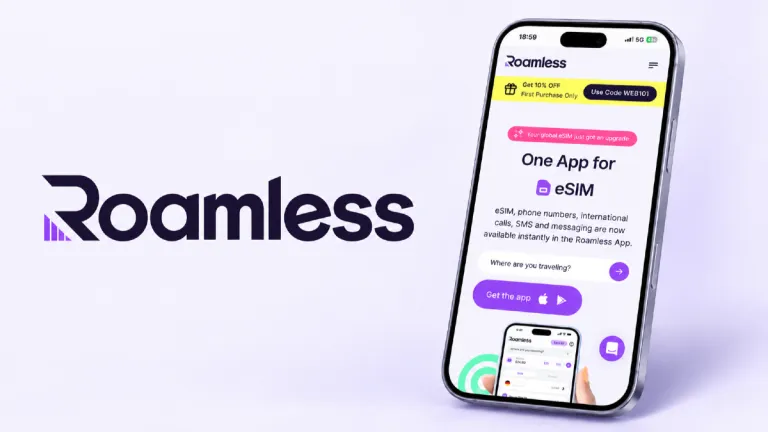
Arriving in another country should not mean worrying about whether your phone will work. Yet for millions of international travelers, staying connected remains an unnecessarily complicated part of traveling. Traditional mobile operators can charge expensive roaming fees, local SIM cards require additional purchases and setup, and many prepaid travel data packages expire before customers have used what they paid for.
Roamless is building a different approach to international mobile connectivity. The startup provides a single digital SIM card that allows travelers to access mobile internet across more than 200 countries and territories, without repeatedly purchasing and installing a new SIM card for every destination. Customers can pay for the data they actually use, keep unused credits for future trips, or select prepaid packages when they need more data.
Founded in 2023 by a team of Turkish entrepreneurs and telecommunications specialists, Roamless has grown into a US-headquartered connectivity company serving more than one million travelers worldwide. By December 2025, it had secured $18 million in disclosed funding, expanded its partnerships with major travel and financial companies, and developed its own telecommunications infrastructure to support its services.
What began as an attempt to eliminate a familiar travel frustration is developing into something more ambitious: a mobile connectivity service designed around people who regularly cross borders rather than a traditional network restricted primarily to one country.
How Roamless Works and Why One eSIM Can Replace Multiple Travel SIM Cards
The central idea behind Roamless is straightforward. Instead of purchasing a different SIM card whenever they travel internationally, users install one Roamless eSIM on their compatible smartphone and reuse it across supported destinations.
An eSIM is a digital version of the physical SIM card traditionally inserted into a mobile phone. Rather than relying on a removable plastic card, the phone stores the necessary mobile network information electronically. This allows users to activate compatible cellular services without visiting a shop or handling a physical SIM.
To get started with Roamless, customers download its application, create an account, and install the global eSIM. Installation requires an internet connection and a compatible device, but once the eSIM has been configured, it can remain installed for future trips. The user then adds prepaid credit or purchases a data plan through the application.
When arriving in another supported country, the customer activates the Roamless eSIM for mobile data. The service connects through an available local partner network, allowing the phone to access the internet without using the customer’s regular mobile operator for international data roaming.
Consider a traveler who lives in Sweden and has an upcoming journey through Japan, South Korea, and Thailand. With traditional travel SIM arrangements, that person might need to purchase different data packages for different destinations or rely on a regional plan with a fixed expiration date.
With Roamless, the traveler can install the eSIM before leaving Sweden, add funds to the account, and use the same digital SIM throughout the journey. The amount charged for data depends on the country, but the remaining account balance can continue to be used as the traveler moves between supported destinations.
The same system also works for occasional travelers. Someone who visits another country only twice a year can leave the eSIM installed between trips and retain unused pay-as-you-go credits. Because purchased credits do not expire, the customer does not need to buy an entirely new data package simply because several months have passed.
Roamless also allows users to keep their existing SIM or eSIM for their regular phone number, while selecting Roamless for mobile internet. On a compatible dual-SIM device, this means the travel connection can operate alongside the user’s usual mobile service.
The Roamless eSIM itself primarily provides mobile data. The company’s application additionally offers internet-based calling features and supported phone-number services, creating a broader communication product without requiring users to abandon their existing mobile operator.
The Founders Built Roamless Around a Problem They Experienced Themselves
Roamless was established in 2023 by Emre Demirel, Ali Gazioglu, Asim Alp, Selim Aykut, Cagdas Yalti, and Cengiz Oztelcan. Although the company is incorporated in the United States, its origins are closely connected to Türkiye, where members of its founding team had developed extensive experience in telecommunications, technology, finance, and business development.
The story behind the startup involves a particularly interesting combination of long-standing friendships and complementary professional backgrounds.
Four members of the team — Demirel, Gazioglu, Alp, and Aykut — attended Robert College, a well-known educational institution in Istanbul. Demirel, Gazioglu, and Aykut graduated in 2001, while Alp graduated in 1999. Their shared educational background helped establish the relationships and trust that later supported their decision to build a company together.
Their professional experiences were different but well suited to developing an international telecommunications service. Demirel had worked in investment and finance, including experience with Goldman Sachs and Turkish private equity firm Turkven. Gazioglu and Alp brought practical expertise in constructing and operating telecommunications networks, while Aykut concentrated on business design and customer experience.
According to an interview published by Robert College’s alumni magazine, the company’s beginnings can be traced to a trip the four friends took together to attend a cryptocurrency conference. What started as a recreational trip developed into discussions about creating a business that would combine their respective professional strengths.
Demirel had personally experienced the frustration of staying connected while traveling internationally. Even with modern smartphones and increasingly widespread mobile networks, crossing a border could still result in unexpected fees, unreliable service, or the inconvenience of finding a new connectivity provider.
At the same time, eSIM technology was becoming more common in smartphones, creating an opportunity to rethink how people purchased mobile connectivity. The founders recognized that eliminating physical SIM cards was only part of the solution. Travelers also needed a service that could operate across multiple countries without repeatedly forcing them through new purchasing and activation processes.
Their proposed solution was more technically demanding than simply building an application that sold prepaid travel data packages.
Rather than relying entirely on an existing telecommunications provider’s infrastructure, Roamless began developing its own underlying network technology. This required expertise in areas such as international network connections, traffic management, and the systems that allow mobile devices to communicate with different operators.
The company’s broader founding team added expertise in marketing, telecommunications strategy, and corporate development. Cagdas Yalti became co-founder and chief marketing officer, while Cengiz Oztelcan joined as a co-founder and board member.
This mixture of technical knowledge and commercial experience became one of Roamless’s defining characteristics. The founders were not simply attempting to create a more attractive interface for buying mobile data. They wanted to improve the infrastructure and commercial arrangements that determine how international connectivity works.
A Different Pricing Model for Travelers Who Do Not Want Expiring Data
One of Roamless’s most distinctive features is the flexibility of its payment system.
Many traditional travel eSIM providers sell fixed packages. A customer might purchase a specific number of gigabytes for a particular country, with the package valid for seven, fifteen, or thirty days. These arrangements can be convenient for a planned holiday, but they are less attractive when someone uses only a fraction of the included data.
Roamless addresses that problem through its pay-as-you-go system, previously branded FLEX and now commonly described as Roamless Credits.
Customers add money to their account rather than purchasing a fixed amount of data that must be used before a deadline. Roamless deducts the appropriate amount as mobile data is consumed, according to the rates applicable in the country where the customer is connected.
For example, a traveler might add $25 to their Roamless account before leaving home. If the customer uses only a small amount of mobile data during the journey, the remaining balance stays available for another trip. The next destination may have a different price per gigabyte, but the same account balance continues to work without requiring the installation of another eSIM.
This provides a useful distinction between Roamless and providers that focus primarily on destination-specific prepaid packages.
However, the company does not rely exclusively on pay-as-you-go billing. It also sells fixed data packages for individual destinations and regions, allowing customers to choose a defined allowance when they expect heavier usage. These packages generally have a limited validity period, unlike the company’s non-expiring prepaid credits.
In October 2026, Roamless expanded its offering by introducing Unlimited Plans for supported countries and regions. These packages provide unlimited total data usage for a selected number of days, subject to a daily full-speed allowance.
Under the company’s published terms, users receive 3 GB of full-speed data per day. After reaching that allowance, the connection continues at a reduced speed of 1 Mbps until the daily allowance resets. This allows customers to remain online without an additional charge, although activities requiring higher speeds may become less practical.
The different payment options make Roamless suitable for several types of traveler. Occasional users can maintain a small credit balance, frequent travelers can choose the most appropriate package for each journey, and customers expecting substantial daily data consumption can consider the unlimited option.
Crucially, all these options operate through the same Roamless eSIM rather than requiring separate digital SIM installations for each pricing model.
Building Its Own Telecommunications Infrastructure
Behind Roamless’s relatively simple consumer experience is a more complicated technical operation.
Many travel eSIM services operate primarily as distributors of connectivity supplied by telecommunications companies. They purchase access to mobile networks through commercial agreements, package that access into products for travelers, and sell those products through websites and mobile applications.
Roamless has taken a different approach by developing its own telecommunications infrastructure, including a cloud-based system designed to manage mobile connectivity across multiple networks and countries.
In practical terms, this gives the company greater involvement in how its services operate beneath the consumer application. Its technology is intended to coordinate network access, manage connectivity, and support the movement of customers between different countries without requiring a new SIM installation each time.
The company says its engineering team includes professionals who previously helped build international telecommunications networks for major operators such as Deutsche Telekom, Vodafone, A1 Group, and TeliaSonera.
That experience is important because international mobile connectivity involves more than connecting a phone to a nearby cell tower. Network operators must manage how devices are identified, how traffic is routed, which networks can be used, and how charges are calculated when a customer connects outside their home country.
Building technology to manage these operations gives Roamless more control over important parts of the service it offers customers. It also supports the company’s ambition to expand beyond travel data into services involving phone numbers, messaging, and broader telecommunications functionality.
Roamless generally provides access to multiple partner networks in many supported destinations. Where available, customers can manually select another network if their current connection has poor reception or unsatisfactory performance.
For travelers, this adds another layer of flexibility. Instead of being restricted to one partner network in every country, they may be able to switch to an alternative connection supported by the service.
The infrastructure strategy also provides a potential business advantage. By building more of the technology itself, Roamless can develop new connectivity products and integrations that might be harder to introduce through a simple resale arrangement.
This approach requires greater technical investment, but it explains why the company describes its ambition as becoming a global mobile operator rather than merely another travel eSIM marketplace.
From an Early Launch to More Than One Million Travelers
Roamless began publicly testing its service in October 2023, initially concentrating on providing international mobile connectivity through its reusable digital SIM.
Its early development attracted investors relatively quickly. In December 2023, the startup announced $2.6 million in financing backed by investors including Revo Capital and Paribu Ventures.
The company continued expanding its coverage and customer base through the following months. In June 2024, Roamless announced that its seed financing had reached $5 million following additional investment led by Shorooq Partners. The round also involved Revo Capital, Paribu Ventures, Finberg, and DeBa Ventures.
At the time, Roamless reported approximately 120,000 users across 165 countries, demonstrating that the product had begun attracting international customers beyond its original market.
That expansion continued throughout 2024 and 2025 as the company increased its geographical coverage, developed additional features, and established relationships with organizations that could help introduce the product to travelers.
By December 2025, Roamless announced a $12 million Series A financing round led by Rasmal Ventures, with participation from Shorooq, Revo Capital, Finberg, and JIMCO. The announcement brought its total disclosed funding to $18 million.
The financing was accompanied by significant customer growth. Roamless reported serving more than one million travelers across over 200 countries and territories, representing nearly fivefold year-over-year growth. Its workforce had also expanded to more than 55 employees distributed across twelve cities.
The company’s progress has attracted attention from investors with experience in international technology businesses. Its financing provides resources to improve network coverage, develop telecommunications infrastructure, recruit specialists, and build additional commercial partnerships.
Roamless has also announced relationships involving Visa, Heathrow Airport, Istanbul Airport, Vueling Airlines, Flair Airlines, and Grab. These partnerships and promotional collaborations provide opportunities to reach travelers through organizations they already use, rather than relying exclusively on customers discovering the application independently.
For a mobile connectivity company, distribution matters because the need for its service often arises at a specific moment: booking a trip, preparing to leave home, or arriving at an airport. Appearing in the traveler’s existing journey can make discovering and activating a connectivity product considerably easier.
Competing With Airalo, Holafly, and Other Global eSIM Providers
The international eSIM market has become increasingly competitive as smartphones have adopted digital SIM technology and travelers have become more comfortable purchasing connectivity through applications.
Companies such as Airalo, Holafly, Nomad, and Saily offer alternatives to traditional mobile roaming, with different combinations of prepaid packages, regional coverage, and unlimited data options.
Roamless competes in the same broad market, but its approach emphasizes flexibility and continuity between trips.
Its reusable global eSIM removes the need to manage multiple destination-specific installations. Its non-expiring pay-as-you-go credits allow customers to retain purchased value for later journeys, while the additional fixed and unlimited packages give frequent users more choices.
The company’s proprietary telecommunications infrastructure represents another point of differentiation, particularly as it attempts to expand into services that go beyond internet access.
These distinctions do not mean Roamless will always be the cheapest choice in every destination. Mobile data prices vary between countries and providers, and a fixed package from another company may be better suited to a particular journey. Coverage quality can also depend on the available partner networks and the device being used.
For travelers, the practical comparison involves more than the advertised price per gigabyte. Simplicity, expiration dates, the ability to reuse an existing eSIM, available network partners, and the convenience of keeping one account can all influence which service provides the best experience.
Roamless is betting that customers will value a flexible, continuing relationship with one global connectivity provider rather than buying a separate travel product every time they cross a border.
Its strategy could also appeal to remote workers, frequent business travelers, expatriates, and people who regularly visit several countries. These customers often experience the greatest inconvenience from repeatedly managing local mobile arrangements.
Expanding Beyond Travel Data Into a Global Connectivity Platform
Roamless’s long-term plans extend beyond providing inexpensive internet access to tourists.
The company is developing services that combine mobile data, international calling, additional phone numbers, and messaging within one account. Its Android application already advertises second-number functionality and the ability for eligible users to make international calls and send messages through the platform.
Roamless also offers in-app international calling, with charges deducted from a user’s credit balance. This is distinct from traditional mobile voice service because the calls are initiated through the application rather than simply using the customer’s existing mobile number and operator.
The company’s future ambitions include local mobile services in major markets such as the United States, Canada, the United Kingdom, and Australia. It has also identified business integrations and partner services as areas for expansion.
For example, a travel company could potentially include international connectivity as part of a booking or membership experience, while another business could use Roamless’s infrastructure to offer mobile services under its own customer relationship.
This creates opportunities beyond selling small data packages to individual travelers. A company capable of supplying connectivity through commercial partners could reach customers indirectly through airlines, financial institutions, hospitality businesses, and other organizations serving internationally mobile audiences.
Roamless’s own development also reflects a broader change in the telecommunications industry. As smartphones increasingly support eSIM technology, customers have more freedom to choose connectivity based on price, functionality, and coverage rather than the physical SIM card installed in their phones.
Traditional operators remain important because they own and operate much of the infrastructure that mobile devices ultimately connect to. However, digital SIM technology allows services such as Roamless to build different customer experiences on top of those networks.
The company is attempting to take that opportunity further by combining a reusable global SIM, flexible billing, calling features, and its own underlying connectivity systems into one service.
For international travelers, the value of this approach is easy to understand. A phone that continues working across borders without requiring a new purchase, a new SIM installation, or the loss of unused prepaid credit removes several small but persistent frustrations from traveling.
What makes Roamless particularly interesting is that its founders are not treating those frustrations as separate problems. They are building a telecommunications platform around the idea that mobile connectivity should follow the customer wherever they go.
As more people travel, work, and communicate across borders, Roamless is worth spotting because it is attempting to make the concept of a separate mobile service for every country increasingly unnecessary.