Rork Is Turning Simple Ideas Into Real Mobile Apps Without Writing Code
For years, creating a mobile app meant finding someone who could write software, spending money on development, or dedicating months to learning how everything worked. Even a relatively simple idea could become an expensive project once design, programming, testing, and publishing were taken into account. That barrier prevented countless people from turning everyday problems into useful applications, not because their ideas lacked potential, but because building the technology required skills they did not possess.
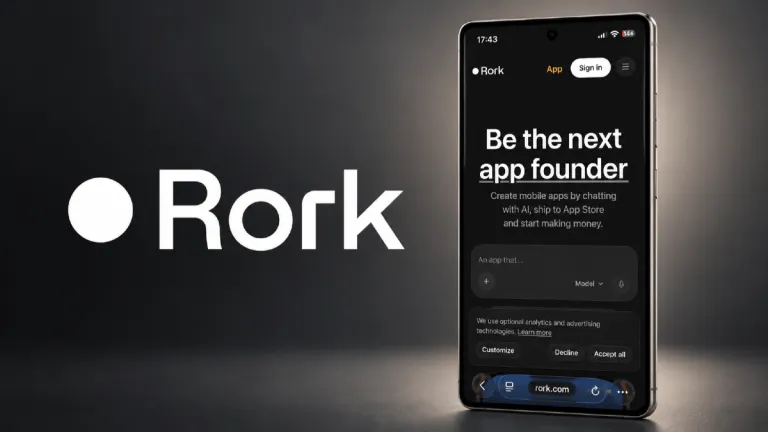
San Francisco-based startup Rork is working to change that. Its AI-powered platform allows users to create functional mobile applications by describing what they want in ordinary English. Instead of writing thousands of lines of computer code, someone can explain an idea, watch the software build an application, and request improvements through a conversation. The result can be tested on a smartphone and eventually published to Apple’s App Store or Google Play.
Founded in 2024 by Daniel Dhawan and Levan Kvirkvelia, Rork has grown from a financially struggling startup into a company that reported approximately two million users by April 2026. Its journey includes a last-minute change in direction, a viral social media post, investment from prominent Silicon Valley backers, and a subsequent $15 million funding round. Behind those milestones is a straightforward proposition: creating mobile software should no longer be limited to people who know how to program.
How Rork Turns a Written Description Into an App
Rork belongs to a growing category of software development tools often described as vibe coding. The term refers to using artificial intelligence to build software through natural-language instructions rather than manually writing the underlying programming code. Instead of explaining every technical detail to a computer, users describe what they want the finished product to accomplish, and the AI translates those instructions into working software.
The process begins with an idea. A user visits Rork, creates a project, and describes the application they want to build. The description can include the app’s purpose, intended audience, main functions, and preferred appearance. Rork then generates the necessary screens, navigation, and programming logic, producing an initial version that the user can inspect and test.
Consider someone who wants to build a simple application for recording daily water consumption. They could ask Rork to create an app where users enter how many glasses of water they have consumed, see their daily total, and review their progress over time. The platform can turn those instructions into an application with buttons, input fields, and screens for displaying the information. This is an illustrative example of the creation process rather than a claim about a particular existing Rork application.
The user can then continue the conversation to make changes. They might request larger buttons, a different background color, an additional statistics screen, or a daily reminder. Instead of returning to a traditional programming environment and editing the software manually, they explain the desired modification and allow Rork to update the project.
One important distinction is that Rork is designed to generate actual mobile applications rather than simply produce images of what an app might look like. The platform creates executable software that can be tested, refined, and prepared for distribution. Rork also supports more advanced capabilities, including connections to databases and external services, although the available features depend on the subscription plan and the type of application being developed.
The Founders Who Almost Ran Out of Money
Rork’s beginnings were considerably less comfortable than its subsequent growth might suggest. Daniel Dhawan and Levan Kvirkvelia met at a hackathon in San Francisco, having both developed an interest in software development during their teenage years. Both grew up in Russia before moving to the United States, and both had already gained practical experience creating mobile applications.
Their shared background was especially relevant to the business they eventually built. They understood not only how applications were programmed, but also how difficult it could be to turn software into something ordinary people could use. Their experience gave them a foundation for developing tools that could automate parts of the creation process.
Before Rork found its direction, the founders had worked on other technology projects, including earlier applications and AI development tools. Their previous experience included the developer-focused project 21st.dev, but finding a commercially successful direction for their new company proved difficult. Dhawan later described launching several unsuccessful projects with Kvirkvelia and receiving more than 100 investor rejections during their fundraising efforts.
The original concept behind Rork was not specifically focused on mobile applications. The founders had been developing an AI programming product aimed at people without extensive technical experience. However, the rapid emergence of competing AI website builders created a difficult situation. Swedish startup Lovable had launched a popular product in a similar category, and Rork’s early version was not ready to compete effectively.
Kvirkvelia proposed a different approach: rather than joining the crowded market for AI-generated websites, they could concentrate on mobile applications, an area they understood from years of personal experience. Creating software for iPhones and Android devices presented additional technical difficulties, but that complexity also represented an opportunity. If Rork could remove those obstacles, its product would address a more specific problem.
The decision came at a financially precarious moment. According to reporting by TechCrunch, both founders had accumulated approximately $15,000 in credit card debt while paying for the computing resources required to operate their AI product. Dhawan was living on a mattress in a friend’s apartment in San Francisco, while Kvirkvelia continued development from Georgia. Their savings were running low, and securing outside investment had proven challenging.
Rather than abandon the business, they concentrated their remaining resources on the new mobile-focused product. That decision would soon transform the company’s prospects.
The Viral Post That Changed Everything
Rork publicly launched its mobile app-building product on February 12, 2025, using a post on X. The announcement attracted some attention, but the response was initially modest. For a small team that had already struggled to attract investment, the launch did not immediately provide the breakthrough they needed.
The turning point arrived on February 24, when entrepreneur and angel investor Matt Shumer published a demonstration of Rork on X. Shumer, who had already supported the founders with an early investment, expressed enthusiasm about the ability to generate iPhone applications through written instructions. His post attracted more than one million views and introduced Rork to a much larger audience of developers, entrepreneurs, and technology enthusiasts.
The effect was immediate. People began trying the platform, creating applications, and sharing their results. Within five days of the viral post, Rork had generated approximately $100,000 in revenue, according to the founders’ account reported by TechCrunch. For a company that had been struggling to cover operating expenses, the sudden demand was extraordinary.
Investors also responded quickly. Entrepreneur Austen Allred committed $100,000 shortly after the post began attracting attention, while other investors, including Hustle Fund and Founders Inc., expressed interest. The growing momentum eventually led to a $2.8 million financing round led by Andreessen Horowitz’s a16z Speedrun program, with participation from Chapter One and a collection of prominent technology investors.
The founders’ experience illustrates the importance of finding the right product for a particular market. Their underlying technical abilities had not appeared overnight, and they had already spent considerable time developing AI software. What changed was their decision to concentrate those abilities on a problem they knew well, combined with an unusually effective moment of public exposure.
From a Simple App Builder to a Broader Development Platform
The initial attraction of Rork was its ability to produce working mobile applications from a short written description. As the platform developed, the company expanded its capabilities to accommodate projects that required more than a few basic screens and buttons.
Rork Pro supports applications built using React Native and Expo, technologies that allow developers to create software for both iOS and Android using a shared foundation. For users without programming experience, the technical details are largely handled by the platform. The practical benefit is that they can work toward creating applications for different smartphone operating systems without building everything separately.
The company subsequently introduced Rork Max, a more advanced product focused on Apple’s native development environment. It uses SwiftUI, Apple’s framework for building applications, and cloud-based Macs running Apple’s Xcode development tools. Rather than simply generating a visual preview, the system can compile an application, identify errors, attempt corrections, and display the result in an iPhone simulator.
Rork Max also expands the types of projects users can attempt. Its supported capabilities include applications for iPad, Apple Watch, and Apple Vision Pro, as well as features such as home-screen widgets, advanced device functionality, and certain three-dimensional experiences. These capabilities are especially relevant to entrepreneurs who want to create applications that make greater use of Apple’s hardware and software ecosystem.
Another significant development came through Rork’s acquisition of Paperline, a company developing AI-assisted tools for creating native Apple applications. The Paperline team joined Rork, bringing additional expertise in Swift development. The acquisition strengthened the company’s technical capabilities and demonstrated its willingness to expand through partnerships and acquisitions rather than relying exclusively on internal development.
The differences between Rork Pro and Rork Max are important for prospective users. Pro focuses on flexible, cross-platform mobile development, while Max concentrates on native Apple applications and more specialized capabilities. Both follow the same general philosophy of allowing people to communicate their requirements through natural language, but they serve somewhat different development needs.
Publishing an App and Building a Business
Generating a working application is only part of the process. Entrepreneurs who intend to reach paying customers also need to test their software, publish it through official app stores, and decide how it might generate revenue. Rork has gradually added capabilities intended to help users move beyond experimentation toward releasing applications that other people can download.
For Rork Pro projects, users can preview applications on their smartphones using Expo Go, a development app that displays compatible projects before they are formally published. Android applications can also be prepared as installation packages for submission through Google Play Console. Rork Max provides a more integrated Apple publishing process, allowing supported applications to be compiled and submitted through its cloud-based development environment.
Publishing still involves requirements imposed by Apple and Google. Developers need the appropriate accounts, must comply with store policies, and remain responsible for the quality and behavior of their applications. Rork helps automate parts of the development and submission process, but using AI does not guarantee that an application will receive approval or function perfectly under every condition.
For entrepreneurs hoping to create commercial applications, Rork also supports connections to services that provide functionality beyond the app itself. These can include databases for storing information, external APIs for retrieving data, and integrations that enable AI-powered features. An API is simply a way for one software product to communicate with another, allowing developers to add capabilities without building every underlying service themselves.
The platform operates through a subscription model. Rork offers a free entry point alongside paid plans that provide additional usage allowances, features, and access to more advanced development capabilities. According to its published FAQ, paid options range from approximately $25 per month to $200 or more, depending on the plan. Usage is managed through credits, meaning people developing complex applications may need to consider how much AI-generated work their subscription allows.
Paid users can also export generated code through GitHub, a widely used service for storing and managing software projects. This provides an important degree of flexibility. Someone might begin by creating an application entirely through Rork and later involve a professional programmer to add specialized features or continue development outside the platform.
Millions of Users and a New $15 Million Investment
Rork’s early growth quickly attracted attention beyond the investors who supported its initial breakthrough. In May 2025, the company reported that more than 100,000 people had already used its platform to create or prototype applications. Its audience included founders, designers, marketers, and individuals pursuing personal software projects.
The startup also began showing evidence that people were willing to pay for the service. Approximately two months after the viral post, Dhawan told TechCrunch that Rork had reached $550,000 in annual recurring revenue. This figure represented subscription revenue expressed at an annualized rate rather than money already collected over a complete year, but it demonstrated meaningful commercial demand from an unusually small team.
By April 2026, the company had reached approximately two million users, according to a Forbes interview with its founders. Rork also announced a further $15 million funding round led by Left Lane Capital, with participation from Peak XV Partners, True Ventures, Goodwater Capital, and existing investor a16z Speedrun, among others.
Together with the previously disclosed $2.8 million round, the announcements brought Rork’s disclosed funding to approximately $17.8 million. The new investment provided resources for further product development, recruiting, and expanding its position in the market for AI-assisted mobile software creation.
The company also reported thousands of founders publishing applications through its technology each week. That represents an important evolution from its original position as a rapid prototyping tool. While generating a demonstration is valuable, helping users release software that other people can actually download creates a different and potentially more durable relationship with customers.
Not every reported growth figure carries the same meaning. Registered users, paying subscribers, published applications, and recurring revenue measure different aspects of a business. Rork’s disclosed milestones demonstrate substantial adoption and financial backing, while its longer-term commercial performance will depend on how successfully it converts experimentation into sustained application development.
Competing in the Fast-Growing AI Development Market
Rork operates in a competitive industry where new AI development tools are appearing rapidly. Products such as Lovable, Bolt, and Replit have helped popularize the idea that people can create software by describing what they want instead of programming everything manually. These platforms differ in their technology and intended audiences, but all reflect the broader movement toward making software creation more accessible.
Rork’s central distinction is its focus on mobile applications. Many AI development products gained popularity by making it easier to create websites and browser-based applications. Building an app intended for installation on an iPhone or Android device introduces additional considerations, including operating-system compatibility, device-specific features, testing, and app-store distribution.
That specialization matters because a website and a mobile application are not always interchangeable. A restaurant might need a straightforward website displaying its menu, while a fitness entrepreneur could want an application with progress tracking, reminders, and access to smartphone health features. The second project presents requirements that a general-purpose website builder may not address as directly.
Rork is not alone in pursuing this opportunity, and competitors are continuously expanding their capabilities. Its advantage is therefore not simply that it uses artificial intelligence, but that it has concentrated its technology, product design, and publishing processes around the particular challenges of mobile development.
The company is also positioned to benefit from a broader change in entrepreneurship. As building software becomes easier, people with detailed knowledge of small industries or specialized customer problems can attempt projects that previously would have been financially unrealistic. A teacher, personal trainer, independent retailer, or hobbyist may understand a useful application concept without possessing the programming skills traditionally needed to create it.
AI-assisted development does not eliminate the importance of designing a useful product or understanding its audience. Successful applications still require thoughtful functionality, reliable performance, and ongoing improvements. What Rork changes is the cost and complexity of reaching the point where an idea can be tested in the real world.
Why Rork Could Change Who Gets to Build Software
Much of the conversation around artificial intelligence focuses on how existing companies can reduce the time required to complete familiar tasks. Rork represents a different possibility: using AI to give people access to activities they could not previously perform at all.
A person who has spent years working in a particular industry may have a better understanding of its everyday frustrations than a software developer encountering that industry for the first time. Traditionally, turning that knowledge into an application required convincing someone with technical experience to build it, paying for development, or acquiring the necessary skills independently.
Tools like Rork create another option. The person who understands the problem can begin developing a solution directly, experimenting with different ideas and observing how the resulting application behaves. They can make improvements before deciding whether the concept deserves additional time, money, or professional assistance.
This shift could influence the kinds of mobile applications that reach the market. Products designed for relatively small audiences become more practical when their creators do not have to support the full cost of traditional development. Specialized utilities, local services, educational tools, and personal productivity applications may become easier to create and distribute.
For Rork, the next challenge is making that accessibility useful beyond the initial excitement of generating an application. The most valuable outcome is not simply allowing someone to create software in minutes, but helping them develop an application that works reliably, reaches its intended audience, and continues to improve.
That is what makes Rork worth spotting. It is attempting to turn mobile app development from a specialized technical profession into a practical tool for anyone with a problem worth solving.