Sintra AI: The Startup Building a Team of AI Employees for Your Business
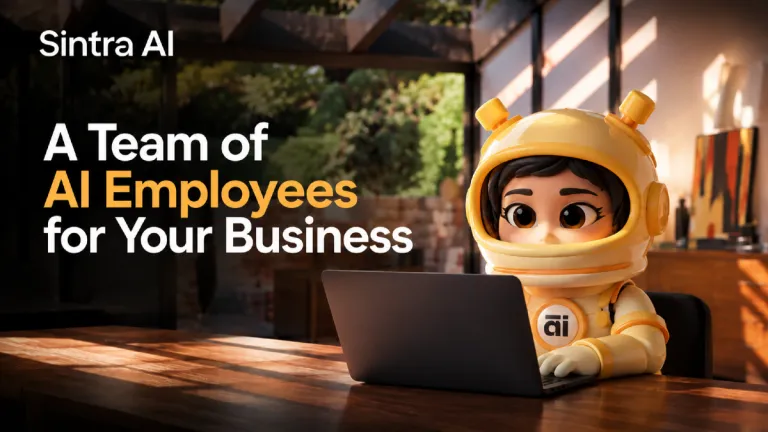
Most AI tools begin with the same idea: give the user one intelligent assistant and let them ask it almost anything. Sintra takes a different approach. Instead of presenting one general-purpose chatbot, it organizes artificial intelligence around the way a small business is already structured, with different AI employees responsible for different types of work.
Sintra.ai gives users a team of 12 specialized AI employees covering areas such as social media, SEO, copywriting, sales, customer support, email marketing and data analysis. They share information about the business through a central knowledge system called Brain AI, allowing the platform to behave less like a collection of disconnected chatbots and more like a digital team that understands the same company.
That idea has attracted meaningful adoption. Sintra says more than 50,000 active users across over 100 countries now use the platform, while outside reporting has put the number of paying customers at around 40,000. The Lithuanian startup also raised a $17 million seed round in 2025, giving it considerably more staying power than the many AI assistants that appear and disappear within months.
From selling prompts to building AI employees
Sintra was founded in Lithuania in 2023, during the period when businesses were rapidly experimenting with ChatGPT and trying to understand how generative AI might fit into everyday work. The project started much more simply than the product that exists today, initially experimenting with curated prompts and tools that could help people get more useful results from AI.
The larger opportunity was not necessarily the prompts themselves. Small-business owners were beginning to use AI for dozens of different jobs, but doing so often meant repeatedly explaining the same company, customers, products and objectives to a general-purpose chatbot. Getting consistently useful results also required users to know what to ask and how to structure their instructions.
Sintra eventually rebuilt the product around specialized AI assistants. Sintra 2.0 launched in May 2024 with the idea that users should be able to choose an AI employee according to the job they wanted completed rather than construct the right prompt from scratch. Reported figures suggest the rebuilt product found its market quickly, reaching $1 million in annual recurring revenue within 57 days.
The business continued growing from there. By 2025, outside reports placed Sintra at approximately $12 million in annual recurring revenue and around 40,000 paying customers. In June of that year, the company raised a $17 million seed round led by Earlybird Venture Capital, with participation from Inovo VC and Practica Capital alongside several angel investors. For a startup founded only a few years earlier, that combination of revenue, customers and outside investment provides unusually substantial evidence that the AI-employee concept has moved beyond an experiment.
Meet the 12 AI employees
The most immediately recognizable part of Sintra is its team. Instead of opening a blank conversation and deciding what role the AI should play, users select an employee that has already been designed around a particular business function. Soshie handles social media, Seomi focuses on SEO, Penn works with copywriting, Milli supports sales, Emmie handles email marketing and Cassie focuses on customer support, while other employees cover areas including data analysis, recruitment, e-commerce and general business assistance.
The names and illustrated personalities make the product approachable, but the more important distinction is specialization. A business owner who wants help researching keywords can go directly to the SEO employee, while someone preparing a campaign can work with the social media or email specialist. The user does not have to begin every conversation by telling a general chatbot what kind of expert it should pretend to be.
That structure is particularly relevant to Sintra's target market. A large company may already employ separate people for SEO, sales, customer support, recruitment and marketing, but a small company often has the same collection of responsibilities concentrated among only a few people. A founder may be answering customer emails, planning social posts, checking analytics and writing sales copy during the same working day.
Sintra is effectively trying to turn those responsibilities into separate destinations inside one product. The AI employees are not equivalent to experienced human specialists, and important work still requires human judgment and review, but they can provide small companies with specialized assistance in areas where hiring a dedicated employee may not yet make economic sense.
Brain AI gives the team shared knowledge
Specialized assistants alone would not make Sintra particularly unusual. It would be relatively easy to create 12 separate chatbots with different system instructions and give each one a job title. The more consequential part of the product is Brain AI, the shared knowledge layer designed to give those employees context about the business they are working for.
Users can provide information about their company, products, customers, brand voice, objectives and working processes. Business documents and other relevant material can become part of that knowledge base, while separate workspaces allow users to organize information for different businesses or projects. Instead of starting from zero whenever a new employee is selected, Sintra can use the stored context when producing work.
Consider a small online business preparing a new product launch. Its copywriter may need to understand the product and brand voice, the social media manager needs much of the same information when creating posts, and the email marketer needs it again when preparing a campaign. Without shared context, the owner spends time feeding similar background information into several different AI tools. Brain AI is designed to reduce that repetition by making company knowledge available across the Sintra environment.
The platform has also been extending the concept beyond conversations. Its employees can work with integrations and recurring processes, moving Sintra toward AI that participates in workflows rather than simply producing text in a chat window. The company's current documentation lists more than 15 integrations as part of Sintra X, connecting the product with external services businesses already use.
That distinction matters because the usefulness of business AI increasingly depends on context and access. An AI social media specialist that understands a company's products, audience and previous work is potentially more useful than one receiving an isolated prompt. Giving multiple specialists access to the same underlying knowledge is one of the clearest ways Sintra differentiates itself from simply opening several separate chatbot conversations.
Why use Sintra instead of a general AI chatbot?
General-purpose AI platforms can already perform many of the individual tasks Sintra offers. ChatGPT, Claude and Gemini can write emails, brainstorm social posts, analyze documents, suggest SEO topics and help create sales copy. A technically confident user can also build custom instructions, projects and workflows around those platforms.
Sintra's proposition is therefore not that these tasks are impossible elsewhere. It is that many small-business owners do not want to spend their time designing their own AI system. They may prefer software in which the roles, workflows and shared business context have already been organized for them.
This makes packaging an important part of the product. Telling a business owner to “ask an LLM to act as an SEO expert” requires a different level of involvement from presenting Seomi as the place where SEO work happens. The underlying artificial intelligence may still depend on large language models, but the experience is designed around delegation rather than prompting.
That can also lower the psychological barrier to using AI across more parts of a company. Someone who originally signs up for help with social media may later use the same subscription for customer support, analytics or email marketing because those capabilities are already represented by other employees in the team. Sintra becomes less about purchasing one AI feature and more about providing a central place for several types of business work.
There are limits to that simplicity. AI can still misunderstand instructions, generate inaccurate information or produce work that does not match what a business needs. The more responsibility a company delegates, particularly for customer-facing communication or decisions involving important business data, the more important human oversight becomes. Sintra's employee metaphor makes the product easier to understand, but it should not be mistaken for the accountability and judgment that come with employing a human specialist.
How much does Sintra cost?
Sintra currently sells the complete team through its Sintra X subscription rather than requiring customers to purchase individual employees. The standard one-month plan costs $97, while a three-month subscription costs $177 upfront, equivalent to $59 per month. A 12-month subscription costs $624 upfront, bringing the effective monthly price down to $52.
Those are Sintra's standard prices rather than temporary promotional offers, which can reduce the advertised cost at different times. All current Sintra X plans include the 12 AI employees, unlimited workspaces, more than 15 integrations and 250 AI credits per month. The company also provides a 14-day money-back guarantee.
Credits are used for certain AI tasks, with different actions consuming different amounts depending on what the system is being asked to do. The monthly allowance resets each month regardless of whether the customer chooses the monthly, three-month or annual billing period, and additional credits can be purchased when required.
At $97 for a single month, Sintra is considerably more expensive than a basic subscription to many general-purpose AI chatbots. The value proposition therefore depends heavily on whether a customer actually uses the broader team. Someone who only needs occasional help writing copy may struggle to justify the difference, while a founder regularly using several employees for marketing, sales, analysis and support is making a different comparison.
That comparison is closer to the combined cost of multiple business tools and outsourced work than the price of one chatbot. Sintra does not need every AI employee to replace a full-time human for that equation to become interesting. If several of them consistently remove repetitive tasks from a founder's week, the subscription can serve a practical role even while humans remain responsible for the work that requires experience, judgment and accountability.
The rise of the AI workforce
Sintra is part of a broader shift in how business software is being designed and marketed. Traditional SaaS products generally provide tools for employees to operate: accounting software for accountants, marketing software for marketers, analytics platforms for analysts. AI makes it possible to package software around the job itself, which is why terms such as AI employee, AI agent and AI workforce are appearing increasingly often.
For small businesses, that shift could be particularly significant. Historically, a new company often had to choose between leaving work undone, asking the founder to do it or spending money on another employee or contractor. AI introduces another option in the middle: delegate part of the workload to software while keeping a person responsible for reviewing the result.
Sintra's growth suggests there is demand for making that model easier to understand. Reaching tens of thousands of customers, generating millions in recurring revenue and raising $17 million does not prove that AI employees will replace conventional business teams, nor does it need to. The more immediate opportunity is helping smaller organizations handle a wider range of work before they have the resources to build departments around every function.
The harder challenge comes as these systems move from helping with tasks to taking action on behalf of businesses. Writing a draft is relatively low risk; publishing content, communicating with customers or making operational decisions introduces a much higher standard for reliability. The companies building AI workforces will increasingly be judged not only by what their agents can generate, but by how consistently businesses can trust them with real responsibility.
Sintra has chosen to make that transition unusually tangible by presenting AI as colleagues rather than another collection of software features. Whether businesses eventually entrust those employees with entire functions remains uncertain, but Sintra's early growth shows that many are already willing to give them a place on the team.