
Tesana: The AI Game Maker Turning Ideas Into Playable Worlds
Creating a video game has traditionally required some combination of programming, game design, 3D modeling, animation, sound production and a lot of time.
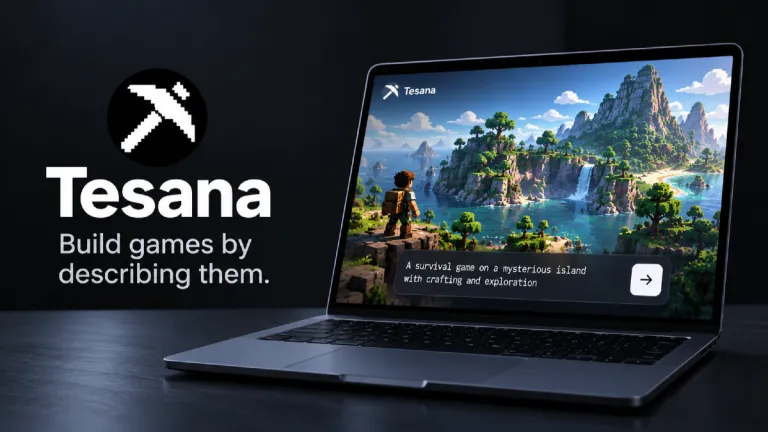
Tesana is trying to reduce much of that process to something almost anyone can understand: describe the game you want to make and let AI start building it for you.
The result is not simply an image, video or simulation of what a game might look like. Tesana creates an actual playable game with real code behind it.
That distinction has helped the platform gain considerable traction in a short period of time. Tesana now says more than 300,000 builders have used the platform, while some individual games published through its community have accumulated tens of thousands of plays.
The company is also moving quickly. During 2026 it has introduced increasingly capable AI models, autonomous game-building features and, most recently, the ability to turn an image into a playable game.
From an idea to a playable game
The basic idea behind Tesana is surprisingly simple.
Instead of opening a traditional game engine and building everything manually, you can describe what you want in normal language.
You might ask for a first-person survival game on a deserted island, a side-scrolling platform game set among floating ruins or an open-world game where players collect and train creatures.
Tesana first creates a plan for the game. The user can review that plan, make changes and then tell the AI to start building.
Behind the scenes, the AI writes code, creates scenes and generates assets such as images, 3D models and audio. When the build is finished, the game can be played directly inside Tesana.
From there, development becomes a conversation.
Instead of manually changing the code, a creator might ask Tesana to make a character jump higher, add background music, introduce another enemy or change how a particular level works.
More experienced developers are not completely locked out of the technical side either. Tesana includes a code editor for people who want direct control.
The games themselves run on Godot, the open-source game engine. Paid users can export standalone versions of their games as well as the underlying source code.
That makes Tesana closer to an AI-assisted game development environment than a simple game generator.
Tesana is already attracting real users
Tesana was founded in 2026 and is led by co-founder and CEO Johannes Vermandois and co-founder and CTO Eric Heimer.
The company introduced itself to the wider game development industry at the 2026 Game Developers Conference in San Francisco, where Vermandois and Heimer demonstrated how playable games could be created by chatting with AI.
The idea appears to have found an audience quickly.
Within weeks of launching, Tesana reportedly had around 10,000 paying users. The company now says the wider platform has surpassed 300,000 builders.
There are also visible signs of activity inside Tesana itself.
Games published through its discovery section have accumulated significant numbers of plays. Rubberhose Ruckus has passed 30,000 plays, Nova Atlas more than 27,000 and Willowmere more than 25,000. Several other games have reached five-figure play counts.
Tesana has also built an audience on X, where its account has grown to around 10,000 followers since joining the platform in February 2026.
Its LinkedIn audience is considerably smaller, while the company points users toward Discord as one of the main places where its community shares games, gets help and participates in building competitions.
The important traction, however, may be happening inside Tesana itself.
The platform is attempting to create both sides of a game ecosystem: people creating games and people playing what those creators produce.
That could become important if Tesana continues growing.
More than a prompt-to-game generator
AI tools that generate software from natural-language instructions are becoming increasingly common.
Tesana is applying the same idea specifically to games.
But building a game is considerably different from generating a website or simple application. A game needs rules, environments, movement, characters, interactions, graphics and often many interconnected systems.
Tesana has therefore been developing its own models and workflows around game creation.
Its current lineup includes Muranyi and its more capable Atomos model.
Atomos is designed to handle larger and more complicated game ideas, producing game logic, environments and mechanics while reducing the amount of back-and-forth required to reach a usable result.
Tesana has also introduced something called Loop.
Normally, a user gives an AI an instruction, waits for the result and then provides another instruction.
Loop changes that process.
The user describes the game and gives Tesana a budget. The system can then continue working without the creator sitting in front of it.
It builds the game, plays what it has created, identifies areas that could be improved and goes back to work.
A separate AI can evaluate parts of the game against an existing game in the same genre. If something falls short, the system can attempt to rebuild it.
In other words, the AI is not only generating the first version. It can repeatedly work on its own output.
For game creation, where testing and iteration can consume enormous amounts of development time, that may eventually be just as important as generating the initial game.
Now an image can become the starting point
In September 2026, Tesana added another way to create games: images.
Instead of explaining an entire visual style through text, users can provide an image and ask Tesana to turn the idea into a playable experience.
That image could be concept art, a screenshot, an illustration, a photograph or something created with another AI image generator.
Tesana then uses the image as a visual reference while creating the game.
The company says the process can produce a playable result in around five minutes in some cases.
This opens up a different kind of workflow.
Someone could create an image of an imaginary game world first and then use that image as the starting point for an actual game. An artist could upload concept art. A creator who has no idea how to describe a particular visual style could simply show Tesana what they have in mind.
Tesana also has an Explore section filled with visual game concepts. Users can select one of those ideas and start building from it.
The combination of image generation and game generation makes the barrier between imagining a game and creating a basic playable version increasingly small.
Building a community around AI-made games
Tesana does not stop when a game has been created.
Games can be published and shared through the platform, giving other users somewhere to discover and play them.
Creators have profiles, and players can follow creators, favorite games and leave comments. Games can also be made available for remixing, allowing another creator to use an existing project as a starting point while keeping attribution to the original.
That makes the platform resemble a mixture of a game engine, an AI coding tool and a creator community.
There is a commercial side as well.
Creators on paid plans receive commercial rights to what they create and can export their projects. Games can also be sold through Tesana’s own store, where the platform takes a 30% share of sales. Games exported and sold elsewhere do not carry the same platform fee.
The current paid plans start at $25 per month for Pro, followed by Max at $50 per month and Ultra at $200 per month.
Usage is based on credits because different AI requests can require dramatically different amounts of computing power. A small change to an existing game may consume relatively few credits, while asking the AI to build or substantially modify a complicated game can require much more.
There are also free daily credits, giving new users a way to experiment before committing to a paid plan.
Who is Tesana for?
Tesana’s most obvious audience is people who have always wanted to create a game but never learned programming.
A person with an idea can now experiment without first spending months learning a traditional game engine.
But that is not the only potential audience.
Independent developers could use it to create prototypes before committing significant resources to an idea. Designers could experiment with mechanics. Artists could turn visual concepts into interactive environments. Experienced developers could use AI to accelerate parts of development that would otherwise require repetitive work.
Even established studios could potentially use tools like Tesana during early experimentation, when the objective is to find out whether an idea is worth pursuing rather than immediately producing a finished commercial game.
That does not mean AI suddenly makes game development effortless.
Creating something technically playable is very different from creating something people want to play for ten hours.
Storytelling, originality, game balance, level design and creative direction still matter. Generating thousands of games also creates the possibility of thousands of forgettable games.
The easier creation becomes, the more important the underlying idea may become.
Tesana itself appears to recognize this shift. Its broader argument is that technical ability should no longer be the main barrier preventing someone from making a game.
Instead, the limiting factor becomes what that person can imagine.
A glimpse at a different future for game creation
The most interesting thing about Tesana may not be any individual game being produced today.
It is what happens if the technology keeps improving.
Website builders gradually changed who could create websites. Smartphone cameras changed who could produce photographs and video. Platforms such as YouTube and TikTok dramatically lowered the barrier to publishing media to a global audience.
AI could potentially create a similar shift in game development.
Tesana is betting that millions of people who enjoy games could eventually become game creators themselves.
There is still a considerable distance between an AI-generated game and the carefully designed experiences produced by major game studios. But Tesana does not necessarily need to replace traditional game development for the idea to work.
It may instead create a new layer underneath it.
People who would never have opened a professional game engine can experiment with an idea, build something playable, share it and see whether anyone wants to play.
And with more than 300,000 builders already experimenting with the platform, that idea is no longer entirely theoretical.
The question is no longer whether AI can generate something that resembles a game.
Platforms like Tesana are beginning to answer a much more interesting question: what happens when almost anyone can make one?