
TesterArmy Raised $1.2 Million to Catch Software Bugs Before Users Do
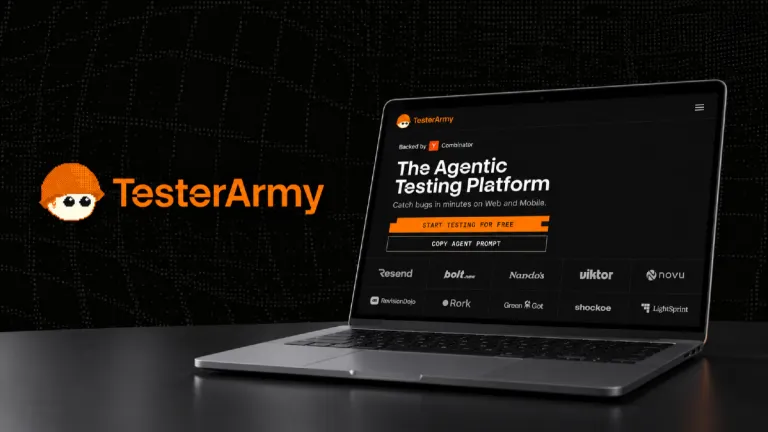
Two young Polish developers who originally hoped to earn enough from a side project to cover their rent have turned that idea into a venture-backed startup attracting international customers and some of Silicon Valley’s most prominent technology investors. Their company, TesterArmy, uses artificial intelligence to test websites and mobile applications automatically, identifying bugs and broken features before real customers encounter them.
Founded by Szymon Rybczak and Oskar Kwaśniewski, TesterArmy joined Y Combinator in spring 2026 and raised $1.2 million in pre-seed funding just months later. By September, the startup had attracted approximately 50 paying customers and was generating several hundred thousand dollars in annual recurring revenue, according to its founders.
The business addresses a problem that has become increasingly important as AI-powered tools make software easier to create. While developers can now build websites and applications faster than ever, ensuring that everything works correctly still requires considerable time and effort. TesterArmy wants to simplify that process by allowing AI agents to perform many of the checks traditionally carried out by human testers.
The Problem TesterArmy Wants to Solve
Every website and mobile application needs to work properly before customers start using it, yet even seemingly simple features can malfunction in unexpected ways. An online store might display products perfectly but fail when someone tries to complete a purchase, while a registration form might suddenly stop accepting new users after a routine software update.
These problems are commonly called software bugs, and identifying them is an essential part of developing reliable digital products. Traditionally, developers and software testers have checked applications manually or created automated tests that follow predefined instructions. Both approaches have disadvantages, as manual testing can be time-consuming while conventional automated tests often require programming knowledge and ongoing maintenance.
The challenge is becoming more significant as AI-powered development tools allow individuals and small teams to build increasingly sophisticated applications. Creating a new feature might take only a few hours, but checking that it works across different devices, browsers, and user scenarios can still require considerable effort.
TesterArmy aims to reduce that workload by using AI agents capable of interacting with websites and applications much like human users. Rather than writing complicated testing scripts, customers can describe what they want to check in ordinary English, allowing the system to carry out the necessary actions and identify potential problems.
How TesterArmy Actually Works
Imagine you’ve created an online store selling T-shirts. Before opening it to customers, you want to make sure visitors can browse products, choose a size, add items to their shopping carts, and complete a purchase without encountering problems.
Normally, you would need to go through these steps yourself or hire someone to test them. Another possibility would be to create automated tests, although doing so often requires technical expertise. TesterArmy offers an alternative by allowing you to enter your website address and describe what should happen using a simple instruction.
For example, you could ask the platform to visit your online store, select a T-shirt, choose size large, add it to the cart, and check whether the checkout process works correctly.
TesterArmy then opens the website in a browser and begins interacting with it. Its AI agent identifies the products, clicks the relevant buttons, selects the requested size, and attempts to proceed through checkout, following much the same steps as an ordinary customer.
If everything works as expected, the test is marked as successful. However, suppose the Add to Cart button appears to work but the shopping cart remains empty. TesterArmy can recognize that the expected result hasn’t occurred, record the problem, capture screenshots, and generate a report showing which step failed.
The website owner or developer can then investigate the issue before it affects paying customers. The same approach can be used to check account registration, login forms, password resets, navigation menus, and other important features.
TesterArmy also supports testing mobile applications, including those developed for iPhones and Android devices. Its agents can work with applications that require passwords and login verification, making it possible to examine functions that aren’t accessible to ordinary website visitors.
One of the platform’s most useful capabilities is the ability to repeat these checks automatically. A business could schedule regular tests of its website or connect TesterArmy to GitHub, a service developers use to manage software projects, so that tests run whenever new code is prepared for release.
This helps identify problems introduced by software updates. A feature that worked perfectly yesterday could stop functioning after an unrelated change, and automated testing increases the chance of discovering that issue before customers notice.
TesterArmy doesn’t guarantee that every bug will be found, and more complicated applications may still require human testing and technical expertise. Nevertheless, the ability to automate repetitive checks without writing detailed scripts could save businesses significant time.
The Young Founders Behind TesterArmy
TesterArmy’s origins can be traced to two Polish developers who began their professional careers unusually early. Szymon Rybczak, the company’s CEO, started working as a software developer at just 14 years old and later became involved in React Native, a technology widely used to create mobile applications.
Oskar Kwaśniewski, TesterArmy’s CTO, followed a similar path, gaining experience in mobile software development and contributing to open-source technology projects. The two met while working on software projects in Poland and continued collaborating professionally, developing a working relationship built around solving technical problems together.
Their experience with mobile applications exposed them to the limitations of existing testing tools, particularly the effort required to create and maintain automated checks. They believed there was an opportunity to build something simpler that developers could begin using immediately, without spending weeks learning specialized testing systems.
TesterArmy initially started as a side project while both founders continued working full-time jobs. Their ambitions were modest, with the original goal being to generate a few thousand Polish złoty per month, enough to provide some additional income rather than establish a major technology company.
An early investor eventually noticed the project and expressed interest in its potential. Although those initial discussions did not result in financing, they encouraged the founders to reconsider what TesterArmy could become and whether the problem they were addressing might support a much larger business.
The project initially also involved a third co-founder, Piotr Matyjasik, who subsequently departed following differences over the company’s direction. Rybczak and Kwaśniewski continued developing the platform, eventually deciding to pursue TesterArmy as a full-time business.
From Losing Their Jobs to Y Combinator
The transition from side project to startup happened under unusual circumstances. After working together at several companies, Rybczak and Kwaśniewski joined a German startup, only to lose their jobs three weeks later when the company failed to secure additional financing.
During that same week, they received unexpected news: TesterArmy had been accepted into Y Combinator, the prestigious Silicon Valley accelerator known for backing companies including Airbnb, Stripe, and Dropbox.
Selected for its Spring 2026 program, the startup gained access to experienced entrepreneurs, investors, and an international network of technology founders. However, getting accepted was only the beginning, as the two developers still needed to transform their early project into a product that businesses could reliably use.
According to a September 2026 interview with Forbes Polska, TesterArmy entered Y Combinator with little more than a barely functioning demonstration. Over the following three months, the founders concentrated heavily on developing the software, sometimes missing networking opportunities because they were spending so much time improving the product.
The situation was especially demanding for Rybczak, who was still completing his secondary-school education in Poland. While participating in the accelerator in San Francisco, he spent Sundays studying for his final examinations and traveled back to Poland to take them, balancing school responsibilities with the demands of building a startup.
Meanwhile, the company was beginning to attract interest from developers and potential customers. The founders used X to share their progress and introduce TesterArmy to the software development community, with some posts gaining substantial attention.
During one particularly busy period, they reportedly arranged around 40 sales meetings in just four days. By the end of the accelerator, TesterArmy had moved beyond its early demonstration and was attracting paying businesses interested in automating their software testing.
For two developers who had recently lost their jobs, the experience marked an unexpectedly rapid change in circumstances.
Raising $1.2 Million From Technology Investors
In September 2026, TesterArmy announced a $1.2 million pre-seed funding round backed by Y Combinator, AIP Seed, Eight Capital, and Script Capital, alongside several prominent entrepreneurs from the technology industry.
Among the individual investors were Guillermo Rauch, founder and CEO of Vercel; Charlie Cheever, co-founder of Quora and CEO of Expo; and Zeno Rocha, founder of Resend. Their backgrounds in software development and developer-focused technology made TesterArmy’s approach particularly relevant to their experience.
The investment provided additional resources to expand the engineering team, develop the platform, and attract customers internationally. Unlike startups that raise capital before demonstrating commercial demand, TesterArmy already had paying customers and recurring subscription revenue when the funding was announced.
The company has not publicly disclosed its exact valuation or complete ownership structure. Nevertheless, securing funding from experienced technology investors represented a significant milestone for a business that had originally been intended to generate modest supplementary income.
Paying Customers and Early Growth
By September 2026, TesterArmy had attracted approximately 50 paying customers, according to its founders, including businesses such as Resend, Bolt, Novu, CodeCrafters, Rork, and Nando’s. The customers ranged from smaller technology startups to more established organizations, illustrating how software testing is relevant to companies of different sizes.
In their Forbes Polska interview, the founders reported several hundred thousand dollars in annual recurring revenue, commonly known as ARR. This figure represents the annualized value of recurring subscriptions rather than revenue necessarily collected over an entire year.
Some customers initially subscribed to relatively inexpensive plans before upgrading to subscriptions costing several thousand dollars per month as their testing requirements increased. This gives TesterArmy an opportunity to grow revenue from existing customers as their businesses and software products become more complex.
The platform offers different subscription options depending on how frequently customers need to run tests. As of October 2026, its advertised plans include a free option with five test runs, a $99 monthly Hobby plan with 250 runs, and a $299 monthly Startup plan with 1,000 runs. Larger businesses can negotiate customized enterprise subscriptions.
A test run refers to one execution of an automated test, and the company’s published pricing allows an individual run to last up to 20 minutes. This means a small developer can experiment with TesterArmy at no cost, while a larger company can purchase enough capacity to check its applications repeatedly throughout the development process.
The company has also published case studies describing improvements in customer testing workflows. One example involving Novu reports a 50% reduction in unreliable tests and approximately 30% faster code merges, although these results come from company-published material rather than independently audited research.
For TesterArmy, the early commercial figures suggest that businesses are willing to pay for a simpler approach to software testing. Its next challenge will be retaining those customers, demonstrating consistent results, and expanding beyond its initial customer base.
Why the Market for AI Testing Could Grow
TesterArmy operates in an established industry where businesses already spend substantial resources checking the quality of their software. Popular tools such as Playwright, Selenium, and Cypress allow developers to automate tests, while commercial providers including BrowserStack, QA Wolf, and Momentic offer additional testing services and capabilities.
TesterArmy seeks to differentiate itself by making AI agents central to the testing process, reducing the need for users to understand complicated scripts or testing frameworks. Its approach could make automated testing more accessible to independent developers, small startup teams, and business owners who lack dedicated software testing departments.
Consider someone who creates an application using an AI-powered coding platform. They might be able to develop and launch a working product without extensive programming experience, but that doesn’t necessarily mean they know how to test it thoroughly or identify problems that could affect users.
A tool that allows them to describe what their application should do and automatically checks whether it behaves correctly could help close that gap.
The same opportunity exists for established technology companies that regularly introduce new features. Every software update creates the possibility of unexpected problems, and identifying those problems before releasing the update can reduce customer complaints, development costs, and potential lost revenue.
In October 2026, TesterArmy also introduced an open-source testing framework called e2e, combining conventional automated checks with AI-powered actions. Making part of its technology openly available could help the company reach more developers, establish credibility, and encourage businesses to experiment with its approach before purchasing a subscription.
However, the startup faces considerable competition from both established testing platforms and newer AI-focused companies. Its long-term success will depend on how accurately its agents identify problems, how well the technology performs across complicated applications, and whether businesses consider the service valuable enough to keep paying for it.
From a Side Project to a Global Ambition
TesterArmy’s early development illustrates how quickly a focused software product can evolve into a commercially promising business. What began as a modest idea between two young Polish developers has become a venture-backed startup with international customers, growing subscription revenue, and investors experienced in building major technology companies.
The founders entered Y Combinator with an unfinished product, transformed it into a commercial service during the accelerator, and secured $1.2 million in funding within months. Their progress has been particularly notable given their ages and the relatively short period between beginning the project and attracting substantial international interest.
Yet the company’s ambitions extend well beyond its early success. TesterArmy must continue improving its technology, expanding its customer base, and demonstrating that AI-powered testing can become a dependable part of software development rather than simply an interesting alternative to existing tools.
As artificial intelligence makes websites and applications faster to create, ensuring that those products work correctly could become an increasingly important challenge. TesterArmy is positioning itself to address that need by making software testing as straightforward as describing what users should be able to do.
For two developers who originally hoped their side project might help cover the rent, that idea has already turned into something considerably bigger.