
Totem Is Helping People Find Their Friends Without Cell Service
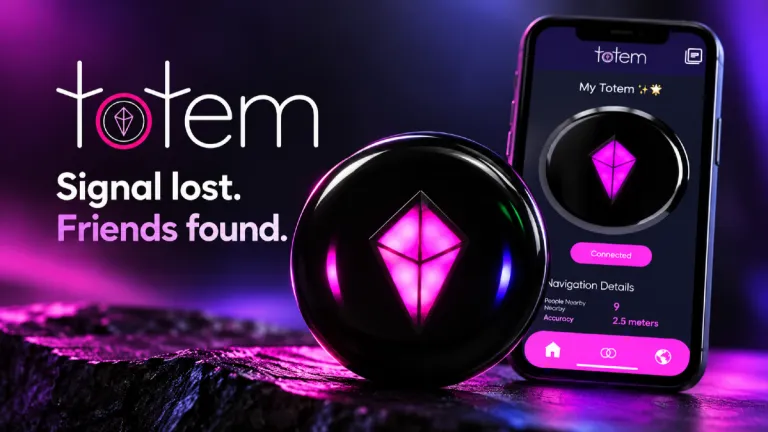
Losing your friends at a crowded music festival is a familiar problem. Thousands of people are moving between stages, mobile networks are overloaded, and sending a message can become almost impossible. What should be a fun experience can quickly turn into hours of searching.
American startup Totem has developed an unusual solution: a small wearable compass that points people toward their friends without needing cellular coverage or Wi-Fi. Instead of making a phone call or checking a map, users simply follow a series of colored lights.
The concept has attracted significant attention. By September 2026, Totem reported more than 65,000 users across 80 countries, while its social media content had generated more than 700 million organic views. For a young hardware company founded in 2024, those figures suggest that its product has connected with an audience far beyond its original festival community.
From a Stolen Phone to a Startup
The story behind Totem began in 2019, when future co-founder Chase Lemonds attended his first major music festival, EDC Orlando. Within two hours of arriving, his phone was stolen, and he subsequently became separated from the friend he had traveled with.
Unable to communicate and surrounded by enormous crowds, Lemonds began thinking about an alternative to conventional mobile phones. He imagined a small device that could guide people back to their friends without relying on the infrastructure that often struggles at crowded events.
The idea remained undeveloped for several years, but it eventually found the right partner.
In 2023, Lemonds met Carter Fowler while they were consulting for the same client. Lemonds was responsible for product development, while Fowler specialized in marketing and design. Their complementary backgrounds made it possible to turn the concept into a potential commercial product.
Both shared an interest in music festivals, and Fowler brought considerable experience from attending live music events. Together, they began developing the Totem Compass during the autumn of 2023.
The company was officially incorporated in January 2024, initially operating with two founders, an early prototype, and limited resources. Development took place before the founders had demonstrated whether people would actually pay for such a device.
Their first major opportunity came when Totem was accepted into the Startup Village at South by Southwest, better known as SXSW, in Austin, Texas.
However, something unexpected happened before the company even arrived at the event.
On February 16, 2024, the founders published a simple Instagram video demonstrating three early Totem Compass prototypes. The devices were positioned together, showing how their lights could indicate the direction of another device.
The demonstration required little explanation. According to Totem, the video received more than eight million views within its first twelve hours.
Suddenly, a small startup with an unfinished consumer product had attracted an international audience. The founders had discovered that their idea addressed a problem people recognized immediately.
A Compass That Points Toward Your Friends
The Totem Compass is a compact electronic device designed to be worn around the neck. Its most recognizable feature is a circular arrangement of colored lights surrounding a central crystal-shaped component.
Each person in a group needs their own compass. Before separating, users connect their devices through a process Totem calls Bonding, which allows the compasses to recognize and communicate with one another.
When someone wants to find a friend, they lift their compass and select the person they are looking for. The illuminated indicators then point toward that person’s approximate direction.
The wearer can simply walk in the indicated direction while the device updates its guidance as the people move.
This approach removes much of the complexity associated with conventional location-sharing applications. There is no need to read coordinates, study a map, or repeatedly call someone who cannot hear their phone.
Up to eight friends can be connected to a single Totem Compass, with different colors helping users distinguish between them. The connections remain saved even when the devices are switched off.
The product also includes a feature called Vibe Mode. When it is not being used for navigation, the compass can display colorful lighting effects that react to surrounding music.
This makes the device more than a purely functional tracking tool. It also becomes a wearable festival accessory that fits naturally into an environment where colorful clothing, lights, and personal accessories are already part of the experience.
Another feature is an SOS button that allows users to send an alert to their connected friends. This can be useful when someone feels unwell, becomes separated from their group, or wants assistance finding their way back.
The SOS function is intended for communication between friends rather than as a replacement for emergency services.
Totem currently lists the standard Compass at $88, with discounted bundles available for groups purchasing multiple devices. Its retail model is straightforward: customers buy the physical product rather than paying an ongoing subscription to use its basic friend-finding capabilities.
How It Works Without Cellular Coverage
The most interesting aspect of the Totem Compass is not its appearance but the technology underneath it.
Modern smartphones can share locations with remarkable accuracy, but most location-sharing applications depend on an internet connection to exchange information. At large outdoor events, cellular networks can become congested as thousands of attendees attempt to use the same infrastructure.
Totem approaches the problem differently.
Each compass uses satellite positioning technology to establish its own location. It then communicates with other compasses using a specialized radio connection rather than conventional mobile internet.
This allows two connected devices to exchange location information directly, even when neither user has cellular coverage.
According to Totem, the maximum direct communication range between two devices is approximately 1,000 meters under suitable conditions.
The company has also developed what it calls the Unity Mesh Network, a system that allows nearby Totem devices to help relay information across greater distances.
For example, imagine two friends standing at opposite ends of a large festival. If they are too far apart for direct communication, other Totem devices positioned between them can potentially pass the necessary information along.
Importantly, these intermediate devices do not need to belong to the same group of friends. Compatible compasses can contribute to the network simply by being present and operating nearby.
This creates an unusual advantage: as more people use Totem at the same event, the network can become more useful for everyone.
That does not mean the compass offers unlimited range in every environment. Performance depends on factors including terrain, obstacles, satellite reception, the number of nearby devices, and the availability of communication paths.
Totem’s technology is particularly suited to outdoor environments, where satellite positioning generally performs better than inside buildings.
The rechargeable device also has a battery designed for extended events. Totem’s published specifications list up to 24 hours in its more economical operating mode, although battery life varies depending on how the device is used.
These practical capabilities help explain why the product has attracted attention in the music festival community. Totem is not simply offering another way to share a location; it is attempting to solve the communication problem that makes existing solutions unreliable in the first place.
From a Viral Video to More Than 65,000 Users
Online popularity does not always translate into a successful business. Many consumer products generate millions of views without demonstrating that people are willing to buy them.
Totem’s development is noteworthy because the company has reported substantial customer adoption alongside its social media success.
Following the February 2024 viral video, the founders experienced an unexpected surge in demand for a product that was still being prepared for manufacturing.
The company made its official public debut at SXSW in March 2024, where visitors could see the device and learn how it worked. At that stage, the founders were operating with a small team while preparing to move from prototypes into commercial production.
During 2024, Totem signed agreements with manufacturing partners and began shipping its first devices internationally in October.
By early 2025, the company reported shipping more than 23,000 compasses to customers across more than 60 countries.
Growth continued through the following festival seasons. By March 2026, Totem reported more than 50,000 users and over $3.5 million in cumulative revenue since launch.
That revenue figure represents sales accumulated since the product’s launch, rather than annual recurring revenue or a single year’s sales.
By September 2026, the company was reporting more than 65,000 users across 80 countries, providing a clearer indication that demand had extended beyond the initial excitement surrounding its launch.
Its social media growth has been equally remarkable.
According to Totem’s own figures, the product generated more than 700 million organic views across social platforms between February 2024 and September 2026. The company also reported building an audience of more than 725,000 followers across its social media accounts.
Totem attributes most of this attention to content published through its own accounts rather than paid influencer campaigns. The company has nevertheless acknowledged running a small advertising campaign in October 2025, which it says was excluded from the organic-view figures.
The distinction matters because online impressions are not the same as unique customers. Millions of views can come from repeated exposure, while customer adoption provides a different measure of commercial demand.
Both sets of numbers are company-reported and have not been independently audited.
Even with that qualification, Totem’s growth represents a notable achievement for a relatively young consumer hardware business.
Funding, Partnerships, and Commercial Expansion
Developing consumer electronics presents challenges that software startups can often avoid.
Hardware companies need to manufacture physical products, purchase components, manage inventory, arrange international shipping, and maintain quality control. Strong demand can become a financial burden when production must expand before customer orders have been fulfilled.
Totem encountered many of these challenges during its first year.
In January 2025, the company reported raising approximately $1.05 million in pre-seed funding, which helped support manufacturing, recruitment, and the expansion of its operations.
The company subsequently opened an equity crowdfunding campaign through Wefunder, allowing community members to invest rather than participate only as customers.
That community funding round eventually closed after raising approximately $1.36 million, according to Totem’s 2026 updates. This was a separate fundraising initiative from the earlier pre-seed financing.
The company also reported receiving a valuation of approximately $15 million in connection with its fundraising activities in late 2025. As with many privately held startups, such a valuation should not be confused with annual revenue or cash held by the business.
Alongside fundraising, Totem has been developing commercial relationships within the live entertainment industry.
In June 2026, it announced a collaboration with American event promoter Relentless Beats involving a limited-edition Totem Compass bundle for the Goldrush: Midnight Riders festival.
The collaboration demonstrated an additional opportunity for the company: selling the product through relationships with event organizers rather than relying exclusively on individual online purchases.
Totem has also experimented with customized designs, accessories, and multi-device bundles. These offerings allow it to appeal to groups of friends, festival communities, and customers who want a more personalized product.
The business remains centered on the physical compass, but the surrounding commercial opportunities could become increasingly important as adoption grows.
A partnership with a festival organizer, for example, might introduce the product to thousands of attendees who already share the exact problem it was designed to solve.
This is a potentially efficient distribution model because the customer can understand its usefulness in the same environment where it will be used.
Testing the Network at Major Music Festivals
One of the biggest questions surrounding Totem has been whether its technology can perform reliably outside controlled demonstrations.
Festivals provide an unusually demanding testing environment. Devices must operate in crowds, across large outdoor areas, amid competing wireless signals, and sometimes through difficult weather conditions.
Totem has been gathering real-world performance data as more customers use its compasses at major events.
At Lost Lands 2026, a large electronic music festival held in Ohio, the company reported having more than 5,000 Totem Compasses operating at the event.
According to Totem, those devices relayed more than 330,000 messages through its Unity Mesh Network over the festival weekend.
The company also reported that a message successfully traveled through 35 consecutive network connections, demonstrating how its system can pass information between devices over multiple stages rather than depending solely on direct communication.
These results are particularly relevant because they show the potential benefits of increasing device density. A large community of users can create a more extensive communication network than a handful of isolated compasses.
Totem has continued improving the existing hardware through software updates rather than requiring customers to purchase a new device whenever improvements become available.
Its Version 5.0 update, released in September 2026, introduced changes to network routing, automatic calibration, and battery performance.
The ability to improve physical products after they have been sold is an important part of Totem’s strategy. Customers can benefit from better functionality while the company continues learning from practical use.
Real-world performance will remain a critical measure of success as Totem expands. A product that helps people find one another must be consistently dependable, especially when buyers are relying on it in unfamiliar surroundings.
The company’s progress at major festivals provides evidence of growing practical adoption, although its reported field-test results remain company-generated rather than independent technical certifications.
A Bigger Opportunity Beyond Music Festivals
Music festivals gave Totem an ideal starting point because they combine large crowds, unreliable cellular connections, and groups of people who frequently separate.
However, the underlying problem is not exclusive to live music.
Families visiting amusement parks, friends attending sporting events, and groups exploring large outdoor attractions can encounter similar difficulties. Parents may also appreciate a simple way to locate children without giving them smartphones.
Totem has identified these broader applications as potential opportunities for expansion.
Outdoor recreation presents another possible market. Groups hiking, camping, or exploring unfamiliar areas may benefit from knowing the direction of other members, particularly where mobile coverage is limited.
The product’s ability to operate independently of conventional cellular networks also raises interesting possibilities for organized events where temporary communication is difficult.
However, these opportunities come with different technical requirements. A device designed around outdoor satellite positioning and short-distance radio communication cannot automatically replace specialist equipment used for wilderness navigation, emergency response, or professional communications.
Totem’s commercial future will therefore depend on expanding into situations where its existing strengths provide a genuine advantage.
Its network technology could become an important differentiator. Unlike conventional location-sharing services that depend on centralized infrastructure, Totem allows compatible devices to communicate directly and relay information through one another.
That feature creates the possibility of a growing network supported by its own users.
The company has publicly discussed ambitions to reach 250,000 users worldwide by the end of 2027. This is a target rather than an achieved milestone, but it illustrates the scale of the opportunity Totem believes exists.
Reaching that audience will require continued investment in manufacturing, customer support, distribution, and product reliability.
The competitive landscape will also matter. Smartphones, smartwatches, Bluetooth trackers, and other location-sharing devices are already familiar to consumers, even if their capabilities differ from Totem’s.
The company’s advantage lies in combining a particularly simple experience with communication technology designed for environments where traditional solutions may struggle.
What makes Totem especially interesting is how narrowly it began. Rather than attempting to reinvent personal communication from the outset, the founders concentrated on one recognizable frustration: losing your friends at a festival.
That focused approach made the product easy to demonstrate, easy to explain, and unusually suitable for short-form social media.
Just two years after incorporation, Totem has moved from a prototype and a viral Instagram video to tens of thousands of reported users, millions in cumulative revenue, and a growing international community.
Whether it can expand into a much larger consumer electronics business remains to be seen. But the startup has already shown that solving one small, familiar problem can become the foundation for something substantially bigger.