
Triips Reaches 200,000 Members and 500,000 Social Media Followers
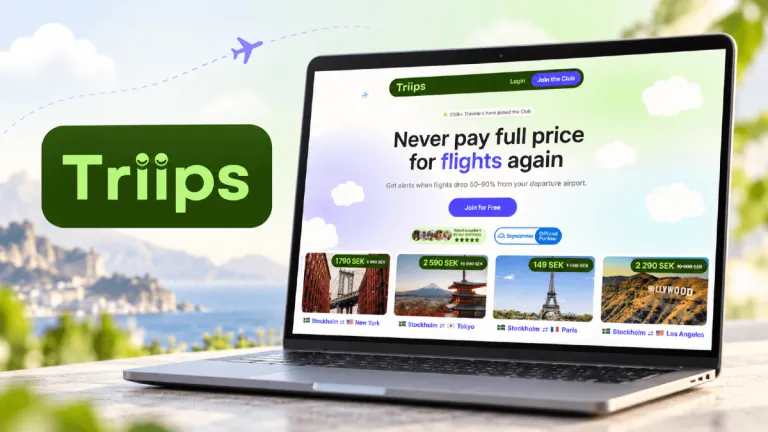
Triips.com is a flight deal subscription service that has turned the search for cheaper airfare into a growing international business. Founded by two travel enthusiasts who spent years exploring the world, the startup uses automated technology to monitor airline prices and alert travelers when unusually inexpensive tickets become available. Triips now claims more than 200,000 members, over $2 million in collective flight savings, and a social media audience exceeding 500,000 followers.
The company's expansion from its beginnings in Toronto to markets across North America and Europe highlights an interesting approach to building a consumer travel business. Rather than selling airline tickets or competing directly with booking platforms, Triips charges a membership fee for discovering discounted flights, while using social media and travel creators to introduce the service to potential customers around the world.
From Traveling Through 100 Countries to Building Triips
The idea behind Triips originated with two friends, Arnaud and Omar, whose shared enthusiasm for travel eventually developed into a business opportunity. According to the company, the pair spent more than a decade backpacking through over 100 countries, gaining firsthand experience of how dramatically airfare prices can fluctuate.
One observation stood out during their travels: passengers sitting on the same aircraft could have paid significantly different amounts for their tickets. The difference often came down to when the booking was made, which routes were considered, and how much flexibility each traveler had.
Over time, the two friends became increasingly skilled at finding unusually inexpensive flights for themselves, their families, and their friends. With backgrounds in technology, they began exploring whether the process could be automated and offered to a larger audience.
Their solution was to develop a system capable of continuously monitoring flight prices and identifying fares that appeared substantially cheaper than usual. Instead of requiring travelers to repeatedly search booking websites, the service would notify them when an attractive opportunity appeared.
Triips began its journey in Toronto, where the company reports attracting approximately 5,000 members during its first month. It subsequently expanded across Canada, adding departure airports in Calgary, Montreal, and Vancouver as its membership reportedly reached 50,000.
The startup then entered the United States, initially targeting major travel markets including New York, Miami, and San Francisco. According to Triips, its technology was adapted to account for the characteristics of American flight routes before the business expanded into Europe, including the United Kingdom, France, and Italy.
Although the company has not published precise dates for every stage of its development, external marketing records show Triips-related promotional activity in 2025. Its LinkedIn company profile lists 2026 as its founding year, which may reflect a later corporate milestone rather than the earliest public availability of the service.
The company now describes itself as a fully remote team of approximately a dozen people representing five nationalities. Its LinkedIn profile identifies Orlando, Florida, as its headquarters and lists Arnaud Goumarre among its team members, while the company's own history continues to emphasize its Canadian beginnings.
How Triips Finds Cheap Flights and How Members Use It
Triips is not an airline, travel agency, or conventional flight-booking website. Its product is a subscription service that searches for unusually inexpensive airfare and emails members when a potentially attractive deal appears.
The process begins when someone registers and selects the city or airport from which they usually travel. Triips then monitors airfare prices across routes departing from that location, comparing available fares with historical pricing patterns to identify substantial price reductions.
According to the company, its technology examines millions of airfare combinations, monitoring fluctuations influenced by factors such as demand, seasonality, and changing airline prices. When a fare falls significantly below its usual level, the system can identify it as a potential deal.
Triips advertises discounts of 50% to 90% compared with regular fares, although those percentages represent its reported comparisons rather than guaranteed savings for every traveler.
Members typically receive two or three curated flight deals per week. The email alerts include the destination, available travel dates, and pricing information, allowing recipients to decide whether a particular opportunity suits their travel plans.
Consider someone living in London who would like to take an international holiday but has not decided where to go. Normally, that person might search individual destinations, compare dates, and repeatedly check airfare prices in the hope of finding something affordable.
With Triips, the traveler can instead receive notifications when the service identifies discounted fares from London. An alert might highlight an unusually inexpensive flight to Rome, Lisbon, or another destination, potentially introducing an opportunity the traveler had not previously considered.
If the offer looks attractive, the member follows the booking link provided in the email. Triips directs travelers to Skyscanner, which displays current flight availability and provides access to the relevant airline or booking provider.
The distinction is important because Triips does not process the flight purchase itself. Its role is to identify potentially valuable opportunities, while the actual booking takes place through established travel-search and ticketing services.
Flight deals are also time-sensitive. The company explains that attractive fares may remain available for less than 48 hours, with some disappearing much sooner. Consequently, a price advertised in an earlier email may have changed by the time someone attempts to book.
The service is particularly suitable for travelers who can adjust their destinations or departure dates. Someone who must travel to a specific city on a particular day may find a conventional flight comparison tool more appropriate, while a flexible traveler can potentially benefit from opportunities across multiple destinations.
How Social Media Helped Triips Reach a Global Audience
One of the most interesting aspects of Triips is the role social media has played in introducing its relatively simple product to an international audience.
In an April 2026 company announcement, Triips reported reaching more than 500,000 followers across its social media channels, including over 430,000 on Instagram and more than 100,000 on TikTok. These company-reported figures represented a substantial audience for a relatively young subscription business.
The strategy revolves around demonstrating the appeal of unexpectedly inexpensive flights through short videos and travel-focused content. Rather than explaining its technology in technical detail, promotional videos often show an unusually cheap fare and introduce Triips as a way to discover similar opportunities.
This approach makes the product easy to understand within a few seconds. A viewer sees an international flight advertised at a surprisingly low price, learns that the service monitors comparable deals, and can investigate whether it offers something useful from their own departure airport.
Independent research into Triips-related creator marketing provides evidence of the strategy's reach. DarkUGC, a platform that tracks promotional content created by social media personalities, identified 44 Triips-related videos from 22 creators published between June 2025 and September 2026.
Collectively, those videos had accumulated approximately 20.5 million recorded views, although the figure represents the tracked sample rather than the total reach of every Triips campaign. Several individual videos attracted more than one million views.
Some of the most successful examples relied on familiar travel-related storytelling, presenting a surprising airfare discovery before directing attention toward the service. Other creators demonstrated flight searches or showed examples of destinations that could be reached at unusually attractive prices.
A September 2025 analysis by Social Growth Engineers also examined the startup's short-form video strategy, identifying around 16 million views associated with its promotional approach at the time. The analysis highlighted how repeated video concepts and recognizable opening messages helped attract attention across numerous creator accounts.
These findings suggest that Triips has made creator-driven marketing an important part of its customer acquisition efforts. Rather than depending exclusively on conventional search advertising, the company can reach travelers through videos they encounter while browsing social platforms.
The strategy also reflects the product's natural appeal to visual storytelling. Cheap flights are easy to demonstrate, widely relevant, and capable of generating curiosity among viewers who may not have been actively planning a holiday.
Triips appears interested in developing this approach further. Its recruitment materials advertise a growth marketing position responsible for content, social media, creator partnerships, and experiments designed to convert attention into new members.
For the startup, the opportunity is to turn a large audience of travel enthusiasts into an ongoing membership community. Social media exposure can generate substantial interest, but the company's longer-term success will depend on whether people continue finding enough value in its flight alerts to remain subscribers.
Triips Reports 200,000 Members and Over $2 Million in Flight Savings
Triips has reported several membership milestones as its operations expanded internationally.
In April 2026, the company announced that it had surpassed 100,000 members, describing its growth across North America and Europe. Its more recent official website information now places membership above 200,000, suggesting that the company has continued attracting sign-ups as its geographic coverage and promotional reach have increased.
The company currently reports monitoring deals from 52 departure cities across 15 countries, with destinations extending to 301 locations in 122 countries.
Those figures illustrate the geographical reach of its offering, although the number of supported departure airports is particularly important. Travelers can only receive relevant alerts when Triips monitors routes departing from their location.
Another prominent milestone is the company's claim that members have collectively saved more than $2 million on airfare. This figure represents estimated savings achieved by travelers rather than revenue generated by Triips itself.
The distinction matters because a travel service can help customers save substantial amounts without receiving those savings as income. Triips earns money through memberships, while the financial benefit from cheaper tickets belongs to the travelers purchasing them.
The reported membership figures have not been independently audited, and the company does not publicly provide a detailed breakdown of active users, paying subscribers, or the proportion of members who joined through promotional trials.
Nevertheless, there are observable signs of consumer activity beyond the company's own announcements.
As of October 2026, Triips had accumulated more than 650 reviews on Trustpilot, with an overall score of approximately 4.5 out of 5. Many positive reviews describe discovering inexpensive fares, saving money on travel, and finding the service easy to use.
Other customers have raised concerns about membership charges, cancellation procedures, refunds, and the usefulness of deals for people who cannot travel flexibly. Triips has responded publicly to some complaints, explaining its subscription terms and directing customers to its support team.
The review activity demonstrates that people are engaging with the service, although a review rating cannot establish the company's revenue or the accuracy of its claimed membership totals.
Combined with its documented creator-marketing activity and expansion into multiple travel markets, the available evidence suggests that Triips has established meaningful consumer visibility beyond its initial launch.
A Subscription Business Rather Than a Flight Booking Platform
The commercial model behind Triips is relatively straightforward. Customers pay for access to curated flight deal alerts, while the company focuses on identifying potential savings rather than handling airline ticket purchases.
New members are offered a seven-day free trial, during which they receive the same flight opportunities as paying subscribers. After the trial period, the membership automatically converts into a paid annual subscription unless canceled beforehand.
As of October 2026, Triips advertises an annual membership costing $59, equivalent to approximately $4.92 per month when calculated across the year. The subscription is billed annually rather than as a conventional monthly payment.
This pricing model gives the company the potential to generate recurring income while allowing travelers to try the service before committing to a full year.
The proposition depends on whether subscribers can find deals that justify the membership cost. A traveler who saves several hundred dollars on one flight could potentially recover the subscription fee through a single booking, although the actual value varies according to travel habits, flexibility, and available fares.
Triips also advertises a savings guarantee for customers who do not save at least $500 during their first year. The guarantee comes with specific conditions, including maintaining membership for the full year, booking at least two flights using Triips deals, and providing supporting documentation.
These details are important because the refund arrangement is not an unconditional promise that any dissatisfied customer can recover the membership fee.
Beyond its airfare alerts, Triips has introduced a feature called Perks Passport, offering members access to selected benefits from travel-related partners. Its website highlights arrangements involving travel insurance, services for travelers, and other offerings intended to reduce the cost of a trip.
These additional benefits provide opportunities to extend the perceived value of membership beyond flight discounts alone. They also connect Triips with other companies serving travelers, potentially creating further commercial relationships as its audience expands.
The startup has not publicly disclosed detailed revenue figures, profitability, or a comprehensive financing history. Its April 2026 announcement described the company as having started through bootstrapping, meaning it initially relied on internal resources rather than a conventional venture capital funding round.
What is evident is that its business model combines an affordable recurring subscription with a customer acquisition strategy capable of reaching large audiences through social media.
That combination is commercially interesting because even a comparatively inexpensive membership can support a meaningful subscription business if a sufficiently large proportion of customers remain engaged and renew their subscriptions.
Competing With Going, Dollar Flight Club, and Traditional Flight Search Engines
Triips operates in a market where travelers already have access to numerous tools for comparing airfare prices.
Its direct competitors include services such as Going, Dollar Flight Club, Jack's Flight Club, and Thrifty Traveler. These businesses similarly help travelers discover discounted flights, often by sending email notifications when attractive fares appear.
The broader competitive landscape includes Google Flights, Skyscanner, and other travel-search platforms that allow users to compare prices, explore destinations, and monitor changes on selected routes.
Triips differs from a conventional flight search engine primarily in how it presents opportunities to travelers. Instead of requiring users to begin with a destination and travel dates, the service searches for discounted fares from a selected departure location and introduces potential destinations as opportunities emerge.
However, this approach is not unique to Triips, since other flight deal subscriptions use similar discovery-based models. Its competitive position therefore depends on the usefulness of its alerts, geographic coverage, membership experience, and ability to reach customers effectively.
Its social media strategy represents one area where the company has achieved visible traction. The extensive creator activity surrounding Triips gives it access to audiences that may be less familiar with established flight deal newsletters.
The startup has also begun developing a broader travel community rather than limiting itself to price notifications.
On its website, members share destination recommendations, photographs, and practical advice from their experiences. These contributions include suggestions for activities in locations such as Bali, Hanoi, Cairo, and Tahiti, allowing visitors to discover things to do after finding an affordable flight.
The community element could become increasingly valuable if it encourages members to engage with the service between trips. Most travelers do not book flights every week, so providing useful destination content may help maintain interest during periods when subscribers are not actively purchasing tickets.
This introduces a different dimension to the company's ambitions. A basic airfare alert service competes largely on price discovery, whereas a travel community can potentially build stronger relationships through shared experiences, recommendations, and ongoing engagement.
The challenge will be balancing those wider ambitions with the original reason customers joined: receiving flight deals that genuinely help them spend less on travel.
Can Triips Turn Viral Attention Into a Lasting Travel Business?
The growth of Triips illustrates how a relatively simple digital service can use automation and social media distribution to reach consumers across international markets.
Its core technology addresses a familiar problem: travelers frequently pay different prices for comparable flights, while identifying the most attractive fares can require considerable time and repeated searching.
By automating that monitoring process, Triips offers a service that is easy to explain and potentially useful to a broad audience. Its creator-led marketing approach then turns the resulting flight discoveries into content that can introduce the product to people who may never have actively searched for such a service.
The next challenge is building lasting value beyond initial interest. A substantial social audience can attract new members, but recurring subscriptions depend on whether travelers continue receiving relevant offers and feel confident that their membership is worth maintaining.
International expansion presents another opportunity. Adding more departure cities could increase the number of potential customers, while a broader network of travel recommendations and partnerships may give existing members additional reasons to remain involved.
Its development also reflects a broader opportunity for consumer startups: a business does not necessarily need a complex product to achieve international attention. A clearly defined problem, an understandable solution, and effective distribution can create a foundation for growth.
For Triips, the combination of automated airfare monitoring, a large social media audience, and an expanding travel community has already produced measurable visibility. Whether that visibility becomes durable commercial success will depend on the company's ability to consistently deliver valuable deals and maintain the trust of its growing membership.