
Uplift Is Building Portable Microhomes That Can Be Deployed Almost Anywhere
A home normally comes with one unavoidable limitation: it stays where it was built.
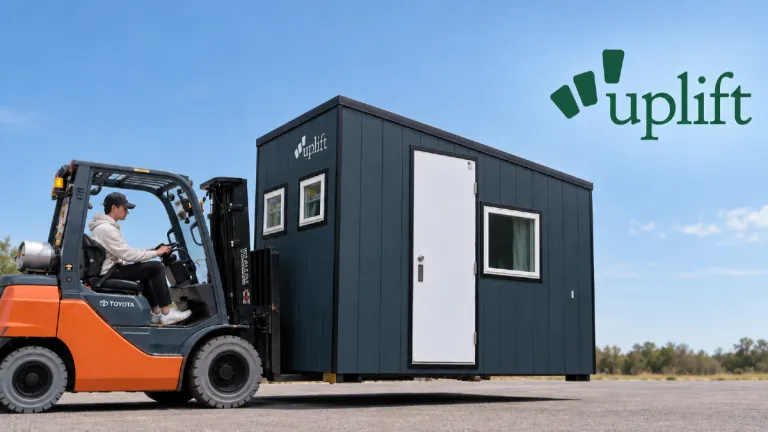
Uplift wants to change that. The Austin-based startup is developing compact homes that can be manufactured in a factory, transported fully assembled on a truck and placed using a standard forklift. Once on the ground, the home can level itself and operate without immediately depending on local power or water infrastructure.
The idea is particularly suited to situations where housing is needed quickly. A natural disaster can destroy thousands of homes in hours, while construction projects in remote areas can create sudden demand for worker accommodation. Traditional housing is difficult to produce at the same speed.
Uplift is trying to make the home itself much easier to move.
The company was founded by Charlie Nitschelm and Trevor O’Leary, engineers with backgrounds at SpaceX and Tesla. After starting as Uplift Microhome, the company emerged publicly as Uplift in 2026 with a $7 million seed round led by Andreessen Horowitz, with Valor Equity Partners also investing.
Uplift is still at an early stage, but it has moved beyond an idea on a presentation. The founders have built working prototypes, opened a factory in Austin, assembled a small engineering and manufacturing team and started selling its first units.
The bigger ambition is much more unusual: Uplift wants to manufacture housing more like the automotive industry manufactures cars.
A 90-Square-Foot Home Designed to Move
Uplift’s current home is roughly 90 square feet and designed for one or two people. That is extremely small compared with a conventional apartment, but the company is not initially trying to replace a normal family home.
Its focus is temporary and transitional housing.
The home arrives assembled rather than as a collection of panels that need to be turned into a building at the destination. A standard forklift can lift the unit from a truck and place it where it is needed.
That changes an important part of the process. Moving a small building is only useful if installing it does not require another large construction project.
Uplift therefore designed self-leveling supports into the home. After the unit is placed, its feet can adjust to uneven ground rather than requiring a conventional foundation to be constructed first.
The home also carries systems intended to reduce its dependence on infrastructure at the destination. Uplift has demonstrated battery power, solar generation and onboard water storage. The design includes the basic features expected from a small living space, including a bed, kitchen and bathroom.
Earlier Uplift prototypes were even smaller. The full-scale prototype demonstrated while the founders were students provided around 60 square feet of living space, with a kitchen, bathroom, bed and hot water. The company has continued developing the product since then.
The result is less like a tiny house intended to remain permanently in someone’s backyard and more like a reusable piece of housing infrastructure.
A unit could be delivered somewhere, used while it is needed and eventually moved somewhere else.
That ability to redeploy the same home is central to Uplift’s argument.
Disaster Housing Was the Starting Point
Natural disasters provided the original problem Uplift set out to address.
A hurricane, wildfire or flood can make large numbers of homes uninhabitable almost immediately. Rebuilding them is a much slower process. Families can spend months in hotels, shelters or other temporary accommodation while their homes are repaired or replaced.
Providing temporary homes sounds like the obvious middle ground, but deploying them can involve more than simply transporting a building.
A site may need to be prepared. Electricity and water may need to be connected. Foundations or supports may be required. Skilled workers and equipment have to reach the area at a time when local infrastructure may already be damaged.
Uplift’s approach is to remove as many of those requirements as possible.
The unit is small enough to transport by truck and designed so a forklift can handle the final placement. Its own power and water systems allow it to function when local utilities are unavailable, while the self-leveling supports reduce the amount of preparation needed before someone can use it.
That could also allow temporary housing to remain closer to the community where someone already lives.
For families displaced by a disaster, location matters. Temporary accommodation hundreds of miles away may provide a roof, but it can also separate people from schools, jobs, neighbors and the place they are trying to rebuild.
Uplift is effectively treating deployment speed as part of the product itself.
The home is important, but so is everything required to get that home from a factory to the person who needs it.
The Founders Want to Manufacture Homes Like Cars
Uplift’s manufacturing philosophy comes directly from the backgrounds of its founders.
CEO Charlie Nitschelm spent around five years at SpaceX and worked on Starlink. Co-founder Trevor O’Leary spent years at Tesla working with vehicle electronics. Both therefore came from companies where producing complicated physical products at increasing scale is a central part of the business.
They are applying some of that thinking to housing.
Most homes are effectively projects. Materials and workers are brought to a location, and the building gradually takes shape on that particular piece of land.
Uplift wants more of that work to happen inside a factory.
The company opened a manufacturing facility in Austin after raising its seed round and began hiring engineers and builders. Instead of sending a construction team to build each home at its destination, Uplift can produce a completed unit on a production line and ship the finished product.
There are obvious limits to the comparison with cars. Buildings face different regulations, local requirements and land-use rules, and Uplift has not yet demonstrated anything close to automotive production volumes.
The company is also only beginning its manufacturing ramp.
But the design reflects the manufacturing strategy. Keeping the unit compact makes transportation easier. Designing it for forklifts simplifies handling. Building power and water systems into the product reduces work at the destination.
In other words, Uplift is not simply trying to build a conventional house faster.
It is redesigning the house around the assumption that it should be manufactured, transported and redeployed repeatedly.
Nitschelm has discussed a long-term target of selling a unit for around $35,000 and making it durable enough to operate for approximately 10 years. Those numbers should currently be viewed as targets rather than established production economics. Uplift is too young to have demonstrated either at scale.
If it can eventually reach them, however, reusability becomes an important part of the economics. A temporary home that can be moved and used repeatedly is a different asset from housing that is built for a single emergency and later discarded.
Uplift Is Already Looking Beyond Natural Disasters
Disaster response may have created the original use case, but it is not difficult to find other situations where portable housing could be useful.
One of the most obvious is workforce housing.
Large construction and infrastructure projects sometimes happen in places where the local housing supply cannot absorb hundreds or thousands of additional workers. Building factories, energy projects, data centers and other major infrastructure can create housing demand before permanent communities have time to develop around them.
Uplift could potentially send housing to the workers rather than waiting for housing to be built nearby.
That gives the company a commercial market that is very different from emergency response.
Disaster housing often involves governments, aid organizations and unusual events. Workforce housing could create more predictable demand from companies that know where projects will happen and approximately how long workers will remain there.
The same basic product could serve both situations because they share a similar problem: people need somewhere to live before conventional housing can be provided.
Other possibilities include temporary accommodation, accessory dwelling units and affordable housing developments. The company has discussed several of these markets, although its ability to serve them will depend partly on regulation and how the product evolves.
Uplift does not need every possible market to work.
The more important question is whether a large enough market exists for a standardized home that prioritizes portability and rapid deployment over living space.
That is a different proposition from the increasingly crowded tiny-home market.
Tiny homes are often sold as permanent lifestyle products for individual consumers. Uplift’s stronger opportunity may instead be selling housing as infrastructure to organizations that need many places for people to sleep quickly.
From an MIT Competition to a $7 Million Seed Round
For such a young company, Uplift has accumulated several meaningful signs of traction.
The company was legally formed in 2025, and the founders developed the business while studying at MIT and Harvard Business School.
Uplift first attracted significant attention through the MIT $100K Entrepreneurship Competition. Its early microhome won the Accelerate stage of the competition before Uplift went on to win the $100,000 Danny Lewin Grand Prize in May 2026.
The competition gave the founders more than prize money. It provided an opportunity to demonstrate a physical product rather than simply pitch an idea.
The team built a fully livable prototype and displayed it at MIT and Harvard. The prototype showed that a very small structure could contain sleeping space, a kitchen, bathroom and hot water while remaining transportable and capable of operating independently from normal utility connections.
A few months later, the company announced a $7 million seed round led by Andreessen Horowitz. Valor Equity Partners also invested.
Uplift then established its factory in Austin and hired roughly 10 engineers and builders during its early expansion. The company said in August that it had already sold its first units and was preparing to deliver a newly manufactured unit to a paying customer.
By September, Nitschelm said Uplift had sold its first unit to a paying customer.
The company also appeared at the U.S. Department of Housing and Urban Development’s 2026 Innovative Housing Showcase on the National Mall in Washington, D.C., where Uplift Microhome Corporation was one of the official exhibitors.
None of this proves that Uplift can manufacture thousands of homes profitably.
It does, however, separate the company from a housing concept that exists only as a rendering. Uplift has raised institutional venture funding, built functioning hardware, established manufacturing space, attracted employees and begun making sales.
For a startup that publicly launched only in 2026, that is meaningful early traction.
The Hard Part Starts After the Prototype
The concept behind Uplift is easy to understand. Executing it at scale will be considerably harder.
Manufacturing physical products requires factories, suppliers, inventory, quality control and capital. Housing adds another layer because buildings are heavily regulated and rules can vary between jurisdictions.
A portable home that technically works anywhere does not automatically have permission to be placed anywhere.
Uplift will therefore have to prove more than whether its engineering works.
The company needs to show that units can be manufactured consistently, survive repeated transportation and deployment, remain comfortable over long periods and operate economically after maintenance, energy, water and transportation are included.
Its target price is another important test.
The approximately $35,000 figure discussed by Nitschelm is based on where the company wants the economics to go. It should not be confused with a broadly available retail price for a mature product today.
The same applies to Uplift’s much larger production ambitions. The founders talk about applying lessons from SpaceX and Tesla and eventually manufacturing housing at enormous volume. That is the direction of the company, not its current scale.
At present, Uplift is a small startup beginning production in one Austin factory.
That distinction actually makes the next stage more interesting.
The first prototype answered whether the company could build the idea. Its early sales begin to answer whether someone will pay for it. The next question is whether Uplift can repeatedly manufacture the same product at a cost that makes the entire model work.
If it can, the company may have found a category that sits somewhere between manufactured housing, temporary accommodation and industrial equipment.
The most important feature may not ultimately be the 90-square-foot home itself. It may be the idea that housing can become a movable asset: manufactured in one place, deployed where demand appears, picked up when that demand disappears and used again somewhere else.
That would make Uplift less like a tiny-home builder and more like a company trying to create a new logistics system for housing.
And for a startup that only began delivering its first homes in 2026, proving whether that system can work is now the much bigger test for Uplift.