Zeely Reports 2 Million Users as Its AI Advertising Business Expands
Creating effective online advertising has traditionally required a combination of marketing expertise, creative skills, and a willingness to experiment with campaigns that may not deliver results. For small businesses, the process can become particularly demanding. Producing promotional videos, designing advertising graphics, writing marketing copy, and managing paid campaigns often involves several different tools or outside specialists.
Zeely, an AI-powered advertising platform founded by Ukrainian entrepreneurs Dmytro Samoiliuk, Yaroslav Samoiliuk, and Alina Bondarenko, is attempting to simplify that process. Its software helps businesses generate promotional content, create AI-powered videos, launch advertising campaigns, and analyze their performance without requiring extensive marketing experience.
Since its official launch in 2022, the company has evolved from a mobile-first website and business creation tool into a broader advertising platform. Zeely now reports more than 2 million businesses and creators using its technology, a workforce exceeding 200 people, and a customer base increasingly concentrated in the United States.
Its expansion has also been accompanied by significant financing activity. Following an early $1 million seed investment in 2023 and a further $1 million investment awarded through a startup competition in 2026, the company disclosed approximately $10.9 million in equity sales through US securities filings in September and October 2026.
For a startup originally built around helping entrepreneurs establish a basic online presence, Zeely’s transformation reflects the growing demand for software capable of handling more of the advertising process through artificial intelligence.
From a Small Ukrainian Team to an International AI Company
Zeely’s story began with its founders’ experience helping businesses establish themselves online.
CEO Dmytro Samoiliuk previously operated a digital marketing agency in Ukraine, gaining firsthand experience with the difficulties smaller companies faced when trying to attract customers through digital channels. Businesses often understood the importance of online advertising but struggled with the technical work, creative production, and ongoing management required to make it effective.
His co-founders brought complementary experience. Yaroslav Samoiliuk, who became chief operating officer, had worked in sales and operational management, including building and scaling sales teams. Alina Bondarenko contributed a background in marketing communications, content creation, and product development.
Their original ambition was not to build an extensive AI advertising platform. Instead, they wanted to make it easier for entrepreneurs to establish an online business and begin promoting their products without hiring developers, designers, or marketing agencies.
The first version of Zeely focused on mobile accessibility, allowing business owners to create a basic online presence and generate promotional materials directly from their smartphones. This approach reflected the founders’ observation that many small entrepreneurs were already managing large parts of their businesses through mobile devices.
Zeely officially launched in 2022, during Russia’s full-scale invasion of Ukraine. The timing introduced considerable uncertainty for the country’s technology industry, but the founders continued developing their product and pursuing opportunities outside their domestic market.
International recognition arrived relatively early. Zeely gained attention at Slush, the prominent European startup event, where it was recognized among the competition’s leading startups. The exposure helped introduce the young company to international investors and the wider technology community.
By April 2023, Zeely had secured $1 million in seed funding from investors including Vesna.Capital, Angel One Fund, Imaguru Ventures, and ZAS Ventures, alongside individual investors Murat Abdrakhmanov and Adrian J. Slywotzky.
At the time, the company employed approximately 11 people and was still primarily associated with helping entrepreneurs create online stores and promote their businesses. Its early international markets included the United States, United Kingdom, Brazil, and Mexico, where mobile commerce and social media provided opportunities to reach smaller merchants.
As the capabilities of generative AI improved, Zeely began shifting its focus toward advertising creation. Rather than concentrating on helping businesses establish an online presence, the company increasingly sought to address the next challenge: producing the advertisements needed to attract paying customers.
That change gradually transformed Zeely into a platform combining AI-generated creative content with advertising campaign management and performance analysis.
How Zeely Helps Businesses Create and Run Advertisements
Zeely’s central proposition is that small businesses should be able to produce and manage professional-looking advertising without needing a dedicated marketing department.
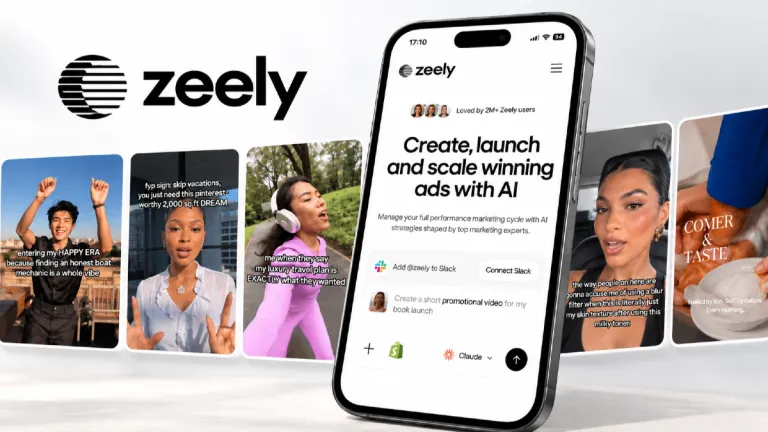
The platform brings several activities into one interface, including image creation, promotional video generation, advertising copy, campaign preparation, and performance monitoring.
A merchant selling skincare products, for example, could begin by entering information about a product or providing a link to an existing product page. Zeely can use that information to create advertising concepts, promotional images, and short videos designed to attract potential customers.
One of its more prominent features is the creation of AI-generated videos that resemble user-generated content, commonly known as UGC. These advertisements imitate the familiar style of social media videos in which someone speaks directly to the camera, explains a product’s benefits, or demonstrates how it is used.
Traditionally, producing this type of content might involve finding a creator, arranging a recording, editing the footage, and paying for revisions. Zeely offers an alternative by allowing businesses to generate promotional videos using AI-created presenters, scripts, and visual elements.
The technology can also create static advertisements using product photographs, marketing headlines, and promotional messages. Businesses can generate several creative variations to explore different ways of presenting the same product.
This matters because advertising performance can depend heavily on presentation. A product might attract customers through a demonstration of its practical benefits, while another audience might respond better to a comparison, special offer, or problem-solving message.
Generating multiple advertising concepts makes experimentation more accessible, particularly for entrepreneurs who lack the resources to produce new creative materials for every campaign.
Zeely’s advertising tools incorporate several AI technologies for generating images, videos, voiceovers, and written content. Rather than requiring users to work directly with each underlying AI model, the platform presents these capabilities through workflows designed around marketing tasks.
Once the content is ready, users can review it, make adjustments, and decide how to distribute it. Advertisements can be downloaded for external use or incorporated into supported campaign workflows.
Zeely currently supports paid advertising campaign management through Meta’s ecosystem, including Facebook and Instagram. It also offers tools for publishing supported organic content on Instagram and TikTok.
Creating an advertisement is not the same as purchasing advertising space, however. Businesses must still establish campaign budgets, approve paid advertising, and cover the cost of reaching potential customers.
The platform also provides reporting tools that help users understand how their campaigns are performing. Metrics such as advertising expenditure, clicks, acquisition costs, and return on advertising spend allow businesses to compare results and decide whether to continue, modify, or stop particular campaigns.
Zeely’s approach is therefore broader than generating AI images or videos. It aims to connect advertising production with campaign execution and the information businesses need to make subsequent marketing decisions.
The company has also described ambitions to introduce more advanced agentic AI capabilities. Rather than performing isolated tasks in response to individual instructions, these systems are intended to coordinate several related activities toward a broader marketing objective.
For example, a future workflow could involve preparing different advertising concepts, evaluating their results, and suggesting subsequent campaign adjustments with less manual involvement. Such capabilities form part of Zeely’s longer-term direction and should not be confused with fully autonomous functionality already available across its current product.
Growth, Customers, and a New Wave of Investment
Zeely’s reported growth has accelerated considerably since its early funding round.
The company now states that more than 2 million businesses and creators have used its technology, compared with figures of more than 650,000 sellers reported in June 2026. Those earlier users were described as operating across approximately 2,000 industries, illustrating the broad audience Zeely is attempting to serve.
Although these figures come from company statements and may use different definitions of users, they indicate the scale of Zeely’s reported expansion.
The company also reports employing more than 200 specialists, a substantial increase from its approximately 11-person team in early 2023. Zeely is headquartered in Wilmington, Delaware, with teams operating in Kyiv, Ukraine, and Warsaw, Poland.
Its international growth has been particularly concentrated in English-speaking markets. According to Zeely, more than 70% of paying customers are based in the United States, with additional customers in Canada, the United Kingdom, and Australia.
That distribution has commercial significance. American businesses operate within one of the world’s largest digital advertising markets, where entrepreneurs routinely spend money on software, marketing services, and tools intended to improve customer acquisition.
Zeely has also publicly associated its expansion with approximately $75 million in annual recurring revenue, or ARR. This metric expresses recurring subscription revenue on an annualized basis and is distinct from the advertising budgets customers spend or the sales they generate through their businesses.
The figure is company-reported and has not been established through independently audited financial statements made available publicly.
The company’s progress has attracted recognition beyond its customer figures. Its three founders have appeared in Forbes’ 30 Under 30 Europe recognition, and Zeely has participated in Google for Startups initiatives while receiving attention through international startup competitions.
One of its most notable achievements arrived in June 2026, when Zeely won The Pitch, a global startup competition organized by Deel and supported by J.P. Morgan.
The competition reportedly attracted more than 50,000 applications, with 84 finalists selected to participate in Paris. Zeely emerged as a winner and secured a $1 million investment from Deel.
For a company seeking greater visibility among international investors, the victory represented another milestone in its transition from an early-stage Ukrainian startup into a larger advertising technology business.
More substantial financing disclosures followed later in the year.
On September 14, 2026, Zeely, Inc. submitted a filing to the US Securities and Exchange Commission reporting approximately $8.84 million in equity securities sold to 24 investors. The filing identified August 31 as the date of the first sale.
A second filing, submitted on October 16, reported approximately $2.09 million in additional equity securities sold to one investor, with the first sale occurring on September 23.
Together, the two filings documented approximately $10.93 million in equity sales. They provide evidence of substantial financing activity, although the publicly available disclosures do not establish a complete lifetime fundraising total, identify every investor, or confirm a company valuation.
The combination of early venture funding, startup competition investment, and subsequent equity financing has provided Zeely with resources to develop its technology and expand internationally.
It also places the company in a more competitive position as the AI advertising industry attracts increasing attention from investors, software startups, and established technology companies.
A Business Model Built Around Recurring Software Revenue
Zeely earns revenue primarily by selling subscriptions to businesses that want to create advertising materials and manage their marketing activities through its platform.
Its published web pricing includes a Starter plan at $29.95 per month, Plus at $49.95 per month, and Growth at $79.95 per month. The plans provide different allowances of credits used to generate content such as AI images, videos, and other promotional materials.
The Starter plan includes 2,500 credits, while Plus provides 5,000 and Growth includes 10,000. This structure allows customers to choose a subscription based on how frequently they need new advertising content.
Zeely also offers shorter introductory subscription options. Those plans can have different prices and renewal conditions, making it important for customers to understand the full subscription terms before purchasing.
The cost of using Zeely’s software is separate from the money businesses spend on advertising itself. A merchant running campaigns on Facebook or Instagram must still fund the advertisements delivered through Meta’s platforms.
For Meta advertising managed through Zeely, the company also documents a service fee of 12% of advertising expenditure, with an optional arrangement that can reduce the fee to 6%.
This creates an additional revenue opportunity beyond the software subscription, while connecting part of Zeely’s business model to customers’ ongoing advertising activity.
The broader commercial strategy reflects a common approach among software companies serving smaller businesses: make it relatively easy for entrepreneurs to begin using a product, then offer higher-capacity subscriptions as their needs become more demanding.
For Zeely, the opportunity is particularly relevant because advertising is not normally a one-time activity. Businesses regularly introduce products, test promotions, refresh creative materials, and adjust their marketing strategies.
Customers who find the platform useful may therefore continue generating new advertisements and managing campaigns over extended periods, creating the potential for recurring revenue.
Competing for the Future of AI-Powered Advertising
Zeely’s expansion comes during a period of rapid development in AI-assisted marketing software.
Specialized competitors such as Creatify focus on turning product information into AI-generated advertising videos, while AdCreative.ai concentrates on producing advertising graphics and creative variations. Canva provides a broader design environment that increasingly incorporates AI features.
Meanwhile, established advertising platforms are introducing more automated creative tools of their own. Meta and Google have been expanding AI-powered advertising capabilities, reducing the amount of manual work required to prepare campaign materials and experiment with different promotional formats.
As these technologies become more accessible, generating an attractive advertisement with AI is no longer sufficient to establish a lasting competitive advantage.
Zeely’s answer is to offer a more connected marketing workflow.
Instead of positioning itself solely as a tool for producing images or videos, the company is attempting to combine creative generation, campaign management, and performance measurement into a system that smaller businesses can operate without extensive training.
Its original mobile-first philosophy remains relevant to that strategy. The platform is intended to reduce complexity for entrepreneurs who may understand their products and customers but lack experience with professional advertising software.
This positioning also gives Zeely a different audience from enterprise-focused marketing technology providers. Rather than concentrating on large advertising teams with substantial budgets, the company emphasizes accessibility for smaller merchants, independent entrepreneurs, and growing brands.
The challenge is that many competing companies are pursuing similar opportunities. AI-generated videos, automated advertising copy, creative testing, and simplified performance reports are becoming standard features across the industry.
Zeely will therefore need to demonstrate value through the overall customer experience, the quality of its generated advertising, and its ability to help businesses manage campaigns efficiently.
Its ambitions around agentic AI could become an important part of that differentiation. A platform capable of coordinating advertising tasks and recommending informed adjustments would offer more than a conventional creative generation tool.
At the same time, online advertising remains dependent on factors that AI software cannot entirely control. Product quality, pricing, customer demand, competition, and advertising budgets all influence whether campaigns generate profitable sales.
The most useful advertising automation platforms will be those that help businesses make better decisions while remaining transparent about the limits of the technology.
The Bigger Picture
Zeely’s evolution illustrates how quickly the market for business-focused AI applications has changed.
A company that initially concentrated on helping entrepreneurs establish an online presence is now competing to automate significant parts of their advertising operations. Activities that once required separate creative tools, advertising specialists, and external production services are increasingly being combined within integrated software platforms.
For small businesses, the appeal is straightforward. Advertising remains essential for reaching customers, but preparing effective campaigns can consume substantial amounts of time and money before results become visible.
Zeely is attempting to make that process more accessible by combining AI-generated content with practical campaign management tools.
Its reported 2 million users, international expansion, growing workforce, and documented financing activity show how far the company has progressed since its 2022 launch.
The next stage will depend on its ability to retain customers, continue improving its technology, and maintain a distinctive position as AI advertising becomes increasingly competitive.
With a substantial reported customer base and fresh investment supporting its ambitions, Zeely has moved well beyond its beginnings as a mobile-first startup. Its longer-term opportunity is to become an everyday advertising platform for entrepreneurs who want to spend less time managing marketing software and more time building their businesses.