
Zest Wants to Replace Restaurant Reviews With Where You Actually Eat
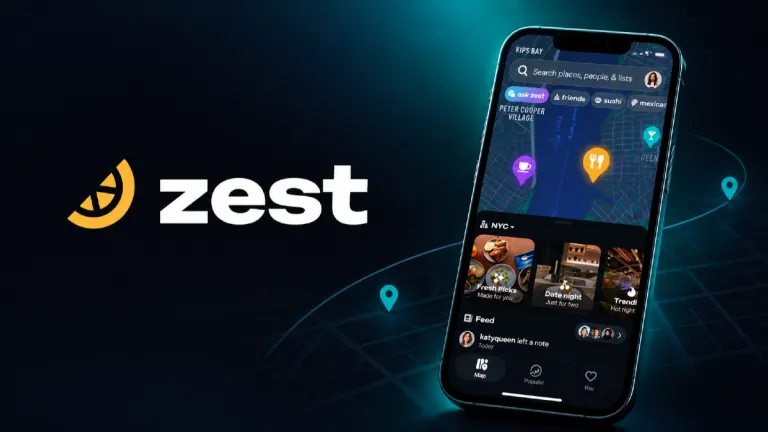
Restaurant reviews tell you where people say they like to eat. Zest wants to learn from something harder to fake: where people actually go.
ZestMaps.com is a restaurant discovery app that can turn a user's real dining history into a personal map of restaurants, cafés, bars and bakeries. Instead of asking people to check in whenever they arrive somewhere, maintain restaurant lists or write reviews after every meal, Zest can connect to a payment card and automatically identify places where the user has eaten.
That history becomes the starting point for personalized restaurant recommendations. Zest looks at where someone goes, which kinds of places they return to, where their friends eat and other signals to suggest somewhere they might enjoy next.
It is a different approach to a problem that already has plenty of solutions. Google Maps and Yelp have enormous collections of ratings and reviews. Instagram and TikTok can turn a restaurant into a viral destination almost overnight. OpenTable and Resy combine discovery with reservations. Zest is betting that another signal can be useful alongside all of them: actual behavior.
Building a restaurant map without checking in
The central idea behind Zest becomes clearer when looking at the work most restaurant apps expect users to do. A person discovers somewhere, saves it to a list, eventually visits, perhaps checks in, rates the experience and then has to remember that information months later when someone asks for a recommendation.
Zest tries to remove much of that process. Users can optionally connect a debit or credit card through Plaid. When the system identifies a transaction from a restaurant, café, bar or similar food-and-drink business, it can add that place to the user's dining history automatically. According to the company, the connection is read-only, Zest does not display how much the user spent, and unrelated purchases are filtered out.
The initial setup can also look backwards rather than starting with an empty profile. Zest says it can map up to two years of previous dining history, which means a new user can potentially begin with a substantial record of where they have eaten rather than waiting months for the app to learn their habits.
Connecting a card is not mandatory. Restaurants can be added manually, and people can use the social and discovery parts of the app without providing transaction access. But automatic tracking is what makes the product unusual. The goal is for the restaurant map to become more useful even when the user is not actively maintaining it.
That history also creates a different kind of taste profile. A five-star rating tells an app that someone says they liked a restaurant. Returning to the same neighborhood Italian restaurant eight times tells it something else. Zest can look at frequency, the types of places someone chooses and other patterns to understand preferences without asking the user to complete a long taste questionnaire.
Recommendations can then incorporate those habits alongside social signals, nearby restaurants and information about the places themselves. The app can also explain some of the reasoning behind a suggestion rather than simply presenting another ranked list.
The distinction matters because restaurant discovery has gradually become crowded with different forms of popularity. Search results favor businesses with large numbers of reviews. Social platforms reward restaurants that photograph well or become part of a trend. Sponsored placements introduce another incentive. Zest is trying to add personal behavior to that equation.
From personal map to social restaurant discovery
The second part of Zest is social. Users can follow friends and see restaurants associated with people whose taste they already know, creating something closer to a living recommendation network than a conventional review database.
That can be particularly useful when traveling. Instead of asking a friend to remember everywhere they ate during a trip to Tokyo, for example, a user could look through the places that appeared on that friend's map. The same principle works closer to home: someone who repeatedly visits good wine bars or small neighborhood restaurants may be more useful to follow than an anonymous reviewer who happened to visit one of those places once.
This social element also explains why comparisons with Foursquare have followed Zest since its launch. Foursquare became one of the defining location-based apps of the early smartphone era by encouraging people to check in at physical places. Zest co-founder Mario Gomez-Hall has described his product as a kind of spiritual successor to Foursquare, but the mechanism is different. Instead of requiring someone to announce each visit, Zest can create the record passively from transaction data.
There is a direct connection between the two products as well. During Zest's beta period, Foursquare co-founder Dennis Crowley was among the people testing it. When WIRED covered Zest's public launch, Crowley's profile reportedly showed more than 1,000 logged visits, and Gomez-Hall said Crowley had provided useful feedback on the product.
Zest has continued expanding the social side since launch. App updates have added a feed where people can interact around dining activity, notes that can be public or private, shareable lists and richer profiles. Verified accounts allow creators, newsletters and other recognizable sources to participate alongside ordinary users.
Restaurant pages have also moved closer to the point where discovery turns into action. Zest now supports links to reservation providers including OpenTable, Resy and Tock, as well as restaurant menus. A person can therefore discover somewhere through their own taste profile or a friend's activity and then move toward making a reservation without beginning another search elsewhere.
The result is increasingly a combination of personal restaurant memory, recommendation engine and social discovery network. The transaction data may be what makes Zest stand out initially, but the usefulness of the product could ultimately depend just as much on how many friends and trusted accounts a user can find there.
A startup years in the making
Zest was founded in November 2024 by Mario Gomez-Hall and Alex Moller, but the product did not immediately appear as a widely available consumer app. The founders tested it progressively, starting with friends and family before expanding the beta to larger groups.
An early App Store version appeared in late 2025, while Zest announced its broader public launch on May 6, 2026. That distinction is important: the startup had already spent considerable time developing and testing the idea before the public launch that introduced it to a wider audience.
The founders also brought relevant consumer-product experience to the project. Gomez-Hall previously co-founded Cymbal, a social music discovery startup centered around sharing and discovering music. He later worked on products at companies including Square and Lyft and became Head of Design at social calendar company Saturn, which was acquired by Snap.
There is a thread connecting those experiences with Zest. Music discovery services have spent years trying to understand taste from behavior rather than requiring listeners to manually describe every preference. Social products become more valuable when information from other people can improve discovery. Zest applies similar thinking to physical places, where the behavioral signal is not what someone listened to but where they chose to eat.
Moller, the technical co-founder, has experience that includes Apple. His path to Zest also predates the product itself. Around the public launch, he described having decided to build his own company roughly two and a half years earlier, with multiple pivots eventually leading to the restaurant discovery product that became Zest.
That longer development history helps distinguish Zest from an app assembled around a single AI feature and launched immediately. AI is part of its recommendation system, but the more fundamental product decision is the data source: using real dining activity to reduce the manual work involved in creating a useful taste profile.
Early traction and $1.8 million in funding
For a recently launched consumer app, one of the harder questions is whether people are actually using it after trying it. Zest has begun producing evidence of activity, although its published metrics need to be interpreted carefully.
The startup has raised $1.8 million in pre-seed funding. Its backers include Seven Seven Six, the venture firm founded by Reddit co-founder Alexis Ohanian, and Kindred Ventures, with Steve Jang among the investors supporting the company.
Shortly after the public launch, TechCrunch reported that Zest had passed 100,000 recorded restaurant visits. The company's current website now reports more than 200,000 verified visits.
Those figures should not be interpreted as 200,000 users or downloads. A regular Zest user can generate many restaurant visits, and the company has not publicly disclosed a comparable total user count. What the metric does show is that the product is processing a growing amount of the behavior on which its central idea depends.
There are other early indicators as well. The iPhone app has accumulated public App Store ratings, and the company has maintained a frequent release schedule since launch. Updates have expanded restaurant search, map behavior, personalized picks, notes, lists, social profiles, reservation options and other parts of the experience rather than leaving the initial product static.
The business model is less established than the product itself. Zest has indicated that restaurants could eventually pay for increased visibility when that exposure results in a customer, rather than simply purchasing a higher position in the recommendation rankings. How significant that model becomes remains to be seen, particularly because maintaining trust in recommendations will be important for a product whose main pitch is that its suggestions reflect genuine behavior rather than paid popularity.
For now, funding gives the small team time to develop that model. The more important early test is whether Zest can turn its initial dining activity into a network that people continue using after the novelty of seeing their restaurant history on a map wears off.
The useful data is also the sensitive data
Zest's biggest product advantage creates its most obvious point of friction. Automatically building someone's restaurant history is convenient precisely because the app is working with information many people consider sensitive.
The company says payment-card connections are handled through Plaid and are read-only. Zest says it cannot move money, does not display transaction amounts and filters the information so that food-and-drink purchases are the relevant activity brought into the product. Users can also choose not to connect a card.
Apple's App Store privacy information provides a broader picture of the data that may be involved when different features are used. The developer's disclosure lists categories that can include financial information, location, contact information, contacts, identifiers and usage data linked to a user's identity. As with other App Store privacy labels, Apple notes that the information is supplied by the developer rather than independently verified by Apple.
That makes trust more important for Zest than it would be for a restaurant app based entirely on manually saved bookmarks. The product has to persuade users that the convenience gained from automatic mapping is worth connecting information about their spending behavior.
There is also a social dimension to that question. Knowing which restaurants friends genuinely visit is useful partly because the information feels more authentic than a public review. But not everyone wants every meal to become social information. Zest says friends see selected dining information such as top spots rather than someone's complete financial activity, giving the company another balance to manage as the social features expand.
None of this makes the model inherently problematic. Transaction data already powers many personal-finance and loyalty products. What is unusual is applying it to restaurant discovery and social recommendations. For Zest, privacy is therefore not a side issue hidden in a settings menu; it is closely tied to the mechanism that differentiates the product.
Zest could become about more than food
The restaurant market gives Zest a useful starting point because eating out naturally combines personal taste, physical location, spending behavior and recommendations from friends. It is also a category where people frequently face the same question: where should we go?
But the underlying idea is broader than restaurants. If a service can learn someone's preferences from places they repeatedly choose rather than from ratings they manually submit, similar signals could potentially be applied to other kinds of local discovery.
Gomez-Hall has already discussed the possibility of eventually moving into areas such as shopping. Even the Zest name avoids tying the company permanently to restaurants, leaving room for a wider interpretation of what a personal discovery map could become.
Expansion would create a different challenge. Restaurant discovery gives the app a clear reason to exist and a recognizable type of behavior to analyze. Moving too broadly could turn a focused product into another general recommendation service competing directly with much larger mapping, search and social platforms.
There may therefore be more value in the method than in covering every category. Google Maps can tell someone what is nearby. Yelp can show what reviewers think. TikTok can reveal what is attracting attention right now. Zest is building around a different layer: the accumulated choices of the individual and the people they trust.
Whether that signal is strong enough to build a large consumer network remains an open question, particularly while the app is young and its disclosed usage remains measured in visits rather than millions of users. But it gives Zest something many new recommendation apps lack: a reason for its recommendations to become more personal as people simply go about their lives.
If Zest can make that passive history useful without asking users to constantly feed the app, its most interesting contribution may not be another way to rate restaurants. It may be showing that the next generation of discovery products can learn more from what people repeatedly choose than from what they remember to review.